
Who learns to lead the new workforce first?


In this article
The companies that learn to lead the new workforce first will be the ones that stop treating AI as software they buy and start treating it as labor they lead. The large AI companies already organize, tier and price digital workers the way a union organizes a trade, and the day an agent gets credentials to your systems it stops being a tool and starts being a worker. That moves a company from headcount alone to headcount plus token count and agent count, and it changes the job at every level: leadership has to understand the work well enough to decide where it goes, managers have to run people and agents together, and every professional has to become the person who directs the agents and decides when not to use them. The risk is not the technology. It is building a company that can no longer function without a handful of suppliers who set the price of its labor.
I am writing this in the middle of a transition. From 2014 to 2026 I built and led Sizebay, a virtual fitting room company for fashion e-commerce; it was acquired in 2024, and my earnout ended in July 2026. During those last two years the AI wave arrived inside the company, and remodeling the team, the product and our direction around it was my job.
So this is not a view from the stands. It comes from trying AI with my own team, from watching how people actually work with it, from watching managers and directors adjust or fail to, and from talking with other executives going through the same thing. And from one observation I could not shake: people delivering in hours what used to take them days or weeks.
Somewhere in that period the problem became clear to me. We are building a new workforce, and our companies are still structured for a workforce made only of people.
From tool to worker, in seven steps
Humanity has changed how it works before. The Industrial Revolution changed physical work and the relationship between people and machines. The digital revolution changed intellectual work: communication, information, productivity. What is starting now is different in kind. Entities that are not human are beginning to produce value directly.
The move can be watched in stages, and most leaders I talk to can point to where their company sits on it.
People working alone. The work is the person.
People working with software. The tool holds records and does arithmetic; the person still does the thinking.
People using AI as a tool. A chat window, a prompt, an answer copied out by hand.
People working side by side with agents. The agent has a job, not only a prompt.
Agents working with relative autonomy. Given a goal, the agent plans, acts and reports back.
Agents receiving credentials. Permissions, responsibilities, access to company systems.
Companies building hybrid workforces. People and digital agents, on the same org chart, whether or not anyone has drawn it.
Step six is the one to watch. The day an agent gets a login to Google Workspace or Microsoft Teams, an inbox, a calendar, a seat in the systems where the company's work actually happens, it stops looking like a tool. It starts behaving like a digital worker. Nobody announces it. It shows up in the access list.
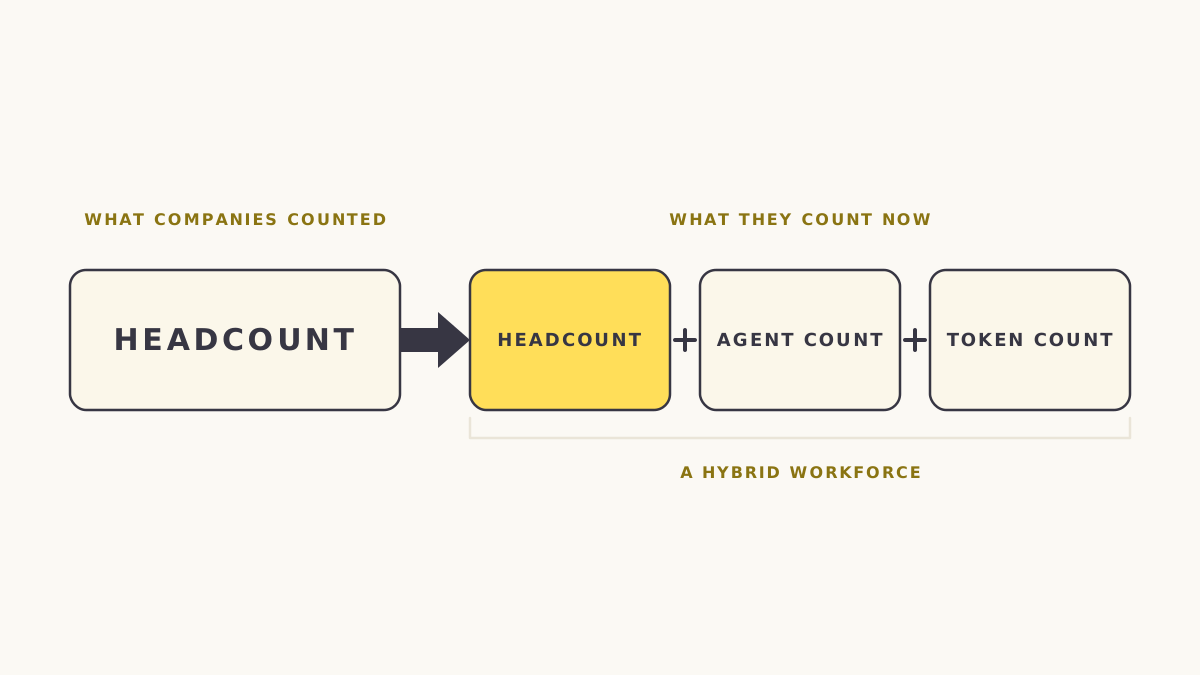
Headcount, token count, agent count
For decades headcount was one of the main variables you used to understand a company. How many people do we have? What does each one cost? What does each one produce? How many more do we need to grow?
That model is starting to change. Not because those questions stopped mattering, but because a second set has appeared next to them.
How many agents do we have?
How many tokens do we consume?
How much work do those agents do?
What does digital labor cost us?
How much value does each agent generate?
Headcount now shares the page with token count and agent count. This is not a euphemism for replacing people with machines. It is a recognition that the workforce of a company is becoming hybrid, and that a number which once described all of it now describes part.
AI companies are becoming digital unions
This is the provocation of the piece, and I mean it more literally than it sounds.
Look at OpenAI, Google Cloud, BytePlus and the other large AI companies. We can keep calling them software companies. I think the label is getting thin.
Open one of their pricing pages and read it as if you were not buying software. It reads less like a software price list and more like a pay scale for digital labor. Different models. Different capabilities. Different performance tiers. Different costs. Different specializations. Choosing one feels less like choosing a plan and more like choosing a professional category: which grade of worker do you want on this task, and what are you willing to pay per unit of their work.
So the question I keep coming back to: what if these companies are no longer simply selling software, but organizing and pricing digital labor?
Because that is what a union does. It organizes categories of work. It defines levels of capability. It sets the rates. It controls access to the capacity. And it largely determines the marginal cost of that kind of work. The difference is that the worker is not human. It is a model. It is an agent. It is a new category of digital professional, and the companies that train and host those models are the ones deciding what it costs.
What changes, at every level
If that is right, this is not a technology story. It is organizational, financial, cultural, managerial and strategic, and a company has to learn to operate with two kinds of workforce at once: humans plus digital professionals. Each level of the company feels it differently.
Top leadership: the risk of strategic irrelevance
Most of today's executives built their careers learning to lead people. Assemble teams, motivate them, delegate, hire, develop talent, make organizational decisions. Those skills still matter. I am not sure they are enough anymore.
The next kind of leadership also has to understand how AI works, how models work and how agents work. Where AI should be used. Where it should not be. How to build systems of work where people and agents share the load, and how to measure the results of both.
The question for a CEO, a founder or a director becomes uncomfortable: will what brought me here, my ability to lead people, be enough to lead a company where a significant share of the work is done by digital agents?
If leadership does not understand AI, it loses the ability to take part in the strategic decisions that will define the company's future. Those decisions still get made. Just not by you.
Management and metrics: headcount is no longer the only number
Traditional management reads headcount, personnel cost, revenue per employee, productivity per employee. In the new model that ledger grows.
Agent count and token count.
Cost per agent and token consumption.
Output per agent.
Revenue generated by a hybrid workforce.
Human cost against digital cost.
Combined productivity.
Underneath it sits a financial question I have not seen answered well anywhere: how do you represent digital labor on an income statement and a balance sheet? Our financial structures were built for an economy where the workforce was almost entirely human. We have to learn how to measure and show, in money, a workforce that is not.
Managers: leading people and agents together
The manager's job changes too. The manager of the near future is not responsible only for people. They are responsible for a combination of people, agents, processes and systems, which means learning to delegate to an agent, follow its results, set its limits, validate what it delivers, and coordinate different kinds of workers on the same outcome.
How do you manage employees who do not sleep, do not eat, and may never complain?
From that one question, a list nobody has finished writing. How do you measure an agent's performance? How do you set its goals? How do you judge quality? How much autonomy do you allow, and how do you know when to intervene? When does a task go back to a person?
Some teams will be a few people coordinating dozens of agents, maybe hundreds. The manager who can do that will look very different from the manager we have been promoting.
The individual professional: the super-professional
At the individual level the change is just as deep. The wrong question is "how do I do my job using AI?" The better one is "how do I expand what I am capable of, using AI?"
The professional moves from executor to orchestrator. They define the problem. They coordinate agents. They validate results, correct errors, make the decisions, and apply the judgment only a person can. They decide when to use AI. And they decide when not to use it.
That last point is the whole thing. The differentiator will not only be knowing how to use AI. It will be knowing when not to.
What I have watched in practice is already significant. People delivering in hours what would have taken days or weeks. Average professionals, properly amplified, reaching output that was hard to imagine a few months earlier. This is observation, not measurement: I watched it happen on my own team. It produces a new category of worker: the super-professional. Not a machine. Not a person who was replaced. A person who was amplified, and who uses agents as an extension of their own capacity.
The big risk: depending on the digital unions
Here is the strategic risk, and it is the reason I wanted the union idea in the title.
Today AI looks extremely cheap next to the cost of a person. That creates an enormous incentive to swap human work for digital work. The long-term question is what happens when a company becomes completely dependent on it.
What happens when employees no longer know how to do certain tasks without AI?
What happens when companies stop building internal capability?
What happens when a few suppliers control the infrastructure of intelligence?
What happens when the cost of those services goes up?
Right now the AI companies are competing with each other for market, capacity and adoption. If dependence becomes structural, the balance of power moves. Whoever controls digital labor gains enormous power over the cost of that labor.
Replacing people with machines is cheap while the machines are cheap. What happens when there are no longer people who can do the work?
In that scenario, the digital union charges what the market will bear, and companies have few alternatives left.
Use AI to consume, or use AI to build
So there is a distinction I think every owner should be making out loud.
Using AI to consume. A company can simply plug external models into endpoints and features that depend on them. That buys speed. It also buys dependence, and the invoice for the dependence arrives later.
Using AI to build. The bigger opportunity is to use AI to develop technology, to grow internal capability, to create intellectual property, to build new products, to automate processes, to raise the productivity of your own people, and to build differentiation that is yours. The company rides the wave without handing its strategic capability to a third party.
Three choices
Faced with this, a company has three paths.
Deny it. Ignore AI and keep operating as before. The risk is irrelevance.
Hand everything over. Replace people indiscriminately and build complete dependence. The risk is losing human capability, autonomy and bargaining power.
Join hands with the technology. Build a working relationship between people and agents, with one aim: use machines to expand human potential. This looks to me like the most powerful path. It is also the one that cannot be bought, only learned.
Humans plus machines
The future is probably not humans versus machines. It is humans plus machines. The organization has to learn to divide the space between the two, which means working out what humans do better, what agents do better, where the two should work together, where a person has to keep control, where a machine can run on its own, and how to build trust, supervision and accountability around all of it.
Underneath that sits a bigger shift than any technology. For centuries, work meant people producing value. Now machines produce work too, and that changes how we think about companies, people, productivity, leadership, management, accounting, pay, strategy and economic power. Call it a new employment contract, still unwritten.
The questions, by level
For CEOs, founders and directors. Will what made you successful so far, your ability to lead people, build teams and make decisions, be enough for what comes next? Are you learning to lead an organization that will have humans and digital agents? Do you understand AI well enough to make strategic decisions about it?
For managers. What are you learning about managing digital agents? Are you prepared to manage workers that do not sleep, do not eat, do not take vacation and may never complain? Do you know when to delegate to an agent and when to bring the task back to a person?
For professionals. How are you using AI to become a super-professional? Are you using it only to do your job faster, or to increase what you are capable of doing? And if you are not doing this yet: why not?
The new workforce is already here
We are probably in front of one of the biggest transformations in the structure of work since the Industrial Revolution. The difference is that this time the revolution is not only creating new machines. It is creating new workers, and I do not think we have fully understood what that means.
The opportunity is not choosing between humans and machines. It is finding out what happens when humans and machines learn to build together. But it has to be done consciously, because replacing people with machines can be cheap at the start, and building a company that cannot exist without them can be very expensive later.
The question is no longer whether AI will change the workforce. It already has. The question is who learns to lead it first.
This is the work Holybiz does with companies, and the way Patricia and I run our own: map how the business actually operates, decide job by job what stays with a person, what goes to an agent and what needs both, and build the agents inside the tools the company already runs, under a named person who checks the work. We operate our own companies with agent teams under human direction, including the site you are reading. It is the third path, in practice, and it starts with the questions above.
The large AI companies are starting to organize, tier and price digital labor the way a union organizes a trade. Their pricing pages read like pay scales.
An agent with credentials to your systems is no longer a tool. It is a worker, and it belongs in the count.
Headcount now shares the page with token count and agent count. Management, metrics and the income statement have to catch up.
Leaders who do not understand AI lose their vote in the decisions that define the company. Managers have to run people and agents together.
Professionals become orchestrators, and the skill that matters most is knowing when not to use AI.
Digital labor is cheap while suppliers compete. Structural dependence hands them the price of your labor.
Three paths: deny, hand everything over, or join hands with the technology. Only the third keeps human capability and bargaining power.
Read next

Customers pay more to the company that looks like it knows what it is doing
A fast first reply, a visit with a checklist, a complete proposal, a short presentation and two follow-ups are not good manners. They are how a customer who cannot judge your work decides what it is worth, and the margin follows that judgment. The research on how people read price, design and trust, and what winning proposals actually contain.
 Patricia de Castro Araujo·Oct 3, 2026
Your week has forty hours of work in it and sixty hours of business
Answering the phone, keeping the feed alive, finding a slot for an estimate, writing the quote, chasing the invoice. None of it is the job the customer pays for, and it is where most of a small-business owner's week goes. What the surveys actually measured, where the government data disagrees with the vendors, and which bucket to hand over first.
Patricia de Castro Araujo·Sep 26, 2026
The customer called while you were on the roof. Nobody answered.
Every service owner I interview tells me the same three stories: the reply that came too late, the quote that went out too late, the day lost confirming what was already agreed. Here is what the sources actually say those three hours cost, which famous numbers I refused to use, and why a company with seventy salespeople bleeds in exactly the same place.
Patricia de Castro Araujo·Sep 19, 2026