
Where does your customer decide now?


In this article
Your customer still researches before buying, but the research increasingly ends inside one generated answer instead of a page of links. That changes what being findable means. A model cannot recommend what it cannot read, cannot compare a price it cannot parse, and will not cite a claim it cannot check. So the work moves from ranking to being legible: publish the answer instead of the teaser, put your prices, hours, coverage area and specifics in text a machine can read, and make sure someone else's page says the same thing about you. What you cannot do is buy your way in or verify your position the way you checked a search ranking, and anyone who promises you a rank inside an AI answer is selling something they cannot deliver.
In 2011 Google gave a name to a moment every business owner already felt: the stretch between hearing about something and buying it, when the customer goes and looks it up. Jim Lecinski called it the Zero Moment of Truth, and the whole point of the name was that the decision had quietly moved away from the shelf and onto the search results page. The shelf was no longer where you won. The search was.
Patricia wrote about ZMOT five years ago, on the blog of Pitada Criativa, the consultancy the two of us started together in 2012. The advice that followed from it was straightforward: rank, collect reviews, be comparable, be visible. That advice was right, and I would still give it for the world it was written in.
I am the one picking it up now because that world moved again, and it moved squarely into the part of it I was standing in.
What actually changed
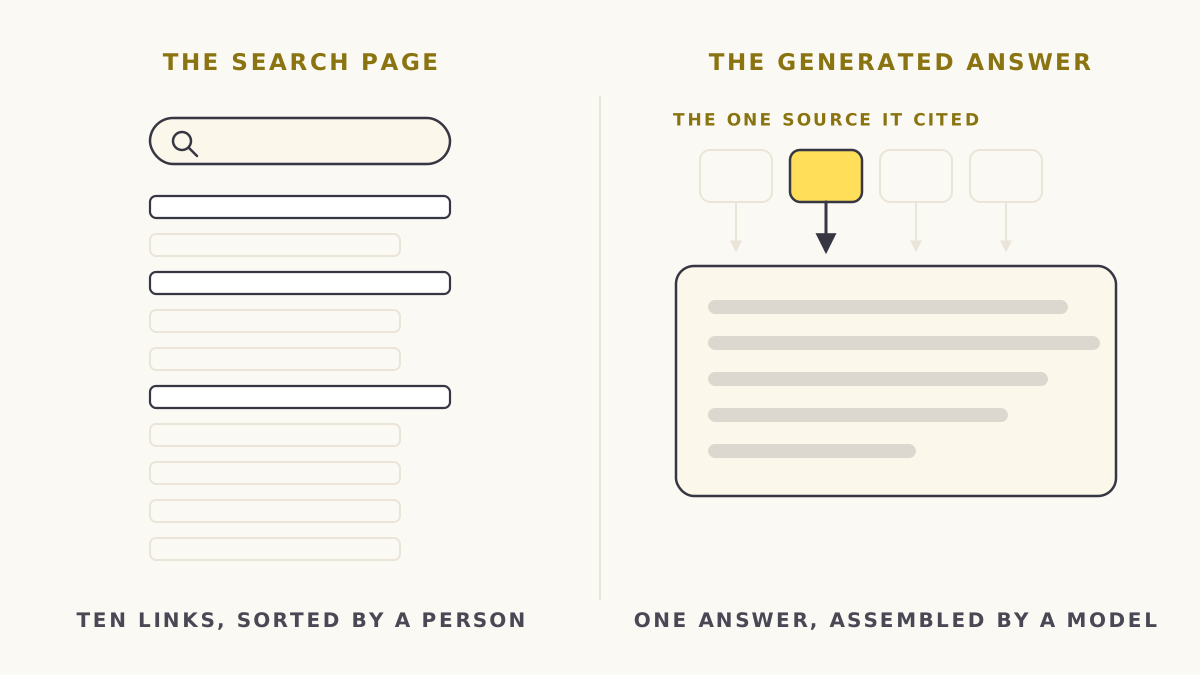
For twelve years the zero moment had a shape you could see. Your customer typed a question, got ten links, opened three, formed an opinion. You could influence that: rank higher, collect reviews, write the comparison page, buy the ad above the fold. You could also measure it, roughly, because you could go type the query yourself and count your position.
Now the same customer types the same question and often reads one answer. Sometimes it is Google's AI Overview above the links. Sometimes they never open a search engine at all and ask ChatGPT, Claude, Gemini or Perplexity directly, in full sentences, the way they would ask a knowledgeable friend: who does this well near me, is this worth it, what should I watch out for, what is a fair price. And increasingly the thing asking is not even the customer, it is an agent the customer pointed at a task.
The zero moment did not disappear. It got compressed into a paragraph, and you are either inside that paragraph or you are not.
The four old pillars, and what each one became
The 2021 version of this advice had four pillars. None of them died. All four changed shape, and the change is the useful part.
Ranking became retrievability. Position on a results page mattered because a human scanned the page. A model does not scan, it retrieves and synthesizes. What gets retrieved is a passage that answers the question directly, in plain text, near the top of a page that is actually about that question. The old craft was earning the click with a headline that withheld the answer. That craft now works against you: a page built to make someone click is a page with nothing quotable in it.
Comparison became parseability. Customers used to build the comparison themselves across three open tabs. Now the model builds the table. If your specifications, coverage area, turnaround time or price live only inside a PDF, a carousel image or a phone call, you are not a column in that table. You are not losing the comparison. You are absent from it.
Reviews became corroboration. Reviews still decide, but they are read differently. A model is looking for whether independent sources agree with what you say about yourself. One consistent story across your site, your Google Business Profile, a directory listing and a customer's own words is worth more than a hundred reviews that contradict your homepage.
Offers became legibility. The old pillar was coupons and price signals. The new one is simply this: if a machine cannot state your price, or at least the shape of it, it will either skip you or guess. Neither is good. You do not have to publish a number. You do have to publish the structure, what it depends on, what is included, what a typical engagement looks like.
The old skill was getting someone to click. The new skill is being worth quoting.
The part nobody wants to say out loud
Here is the honest half, and I would rather lose the sale than skip it.
You cannot buy placement inside a generated answer the way you bought an ad. You cannot check your rank, because there is no rank: two people asking the same question in the same city can get different answers, and so can the same person tomorrow. You cannot make a model cite you by asking it to. And a large amount of what is currently sold as optimization for AI search is guesswork dressed up with a dashboard.
What you can do is real, and it is unglamorous. You can make yourself readable, consistent and checkable. That is not a growth hack. It is the same thing that made a business findable in 2011, applied to a reader that does not have eyes.
What I would actually do this month
If you run a small business and you read all of the above as one more thing to worry about, narrow it to this. None of it requires an agency.
Write the five answers. Take the five questions customers genuinely ask before hiring you, the ones you answer on the phone every week, and put each answer in plain text on your site, with the answer first and the story after. Not a brochure. The answer.
Put the facts in text. Hours, service area, what you do and explicitly what you do not, how pricing works, how long things take, who it is for. Text on a page, not baked into an image, not only in a PDF, not only on Instagram.
Make the story match everywhere. Your site, your Google Business Profile, any directory you are listed in. Contradictions do not just confuse customers, they make you unquotable, because nothing about you can be corroborated.
Ask the machines about yourself. Open ChatGPT, Claude, Gemini and Google, and ask what a customer would ask: who does this in my city, what should I expect to pay, is this company any good. Read what comes back. Where the answer is wrong or empty, that is your work list, and it costs nothing to generate.
Fix the emptiest one first. Not the most annoying. The one where the answer about you is simply blank.
That last step should feel familiar if you have read Patricia on choosing the first process to hand to an agent. Same instinct, different room: start where the work is ready and cheap to get right, not where it hurts most.
What this has to do with Holybiz
I spent twelve years building Sizebay, a virtual fitting room used by e-commerce operations in more than fifty countries, which means I spent twelve years watching how people find, compare and decide online, and watching that behavior change under us more than once. The last two years of it, through the acquisition and the earnout, were spent rebuilding a product and a team around AI. So when I say the decision moment moved, it is not a forecast I read somewhere. It is the change I was standing in.
At Holybiz this is not a separate service with a three-letter acronym. It is part of how we look at a business: what does the outside world, human and machine, actually know about you, and does it match what you would say about yourself. Usually the gap is not a marketing problem. It is that nobody ever wrote the business down.
The zero moment of truth did not go away. It compressed from ten links a person sorted into one answer a model assembled.
Ranking became retrievability, comparison became parseability, reviews became corroboration, and offers became legibility. The four pillars survived, the tactics did not.
A page engineered to earn a click, withholding its answer, is a page with nothing quotable in it. That used to be the craft. Now it is the problem.
Nobody can sell you a position inside a generated answer, and there is no rank to check. Be suspicious of anyone who says otherwise.
The cheapest audit available to you: ask ChatGPT, Claude, Gemini and Google what a customer would ask about your business, and fix the answer that comes back emptiest.
Read next

Customers pay more to the company that looks like it knows what it is doing
A fast first reply, a visit with a checklist, a complete proposal, a short presentation and two follow-ups are not good manners. They are how a customer who cannot judge your work decides what it is worth, and the margin follows that judgment. The research on how people read price, design and trust, and what winning proposals actually contain.
 Patricia de Castro Araujo·Oct 3, 2026
Your week has forty hours of work in it and sixty hours of business
Answering the phone, keeping the feed alive, finding a slot for an estimate, writing the quote, chasing the invoice. None of it is the job the customer pays for, and it is where most of a small-business owner's week goes. What the surveys actually measured, where the government data disagrees with the vendors, and which bucket to hand over first.
Patricia de Castro Araujo·Sep 26, 2026
The customer called while you were on the roof. Nobody answered.
Every service owner I interview tells me the same three stories: the reply that came too late, the quote that went out too late, the day lost confirming what was already agreed. Here is what the sources actually say those three hours cost, which famous numbers I refused to use, and why a company with seventy salespeople bleeds in exactly the same place.
Patricia de Castro Araujo·Sep 19, 2026