
Where does your business keep the truth?


In this article
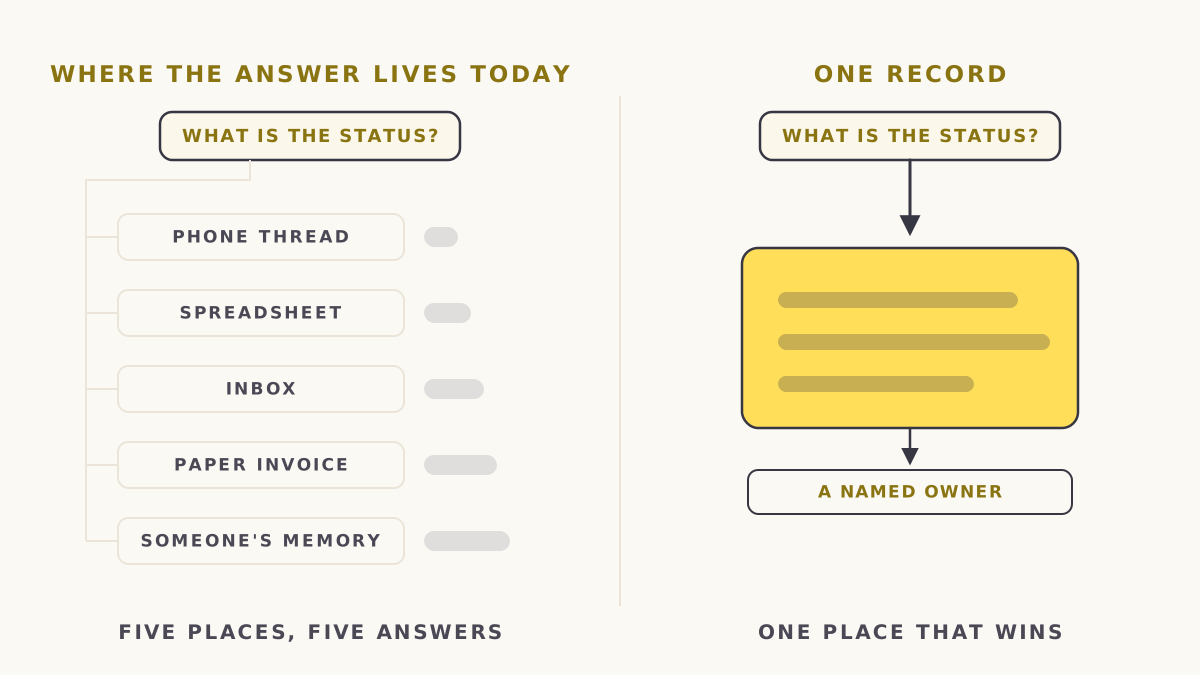
Before you give an agent any job that touches a customer, decide where the truth about that customer lives, and make it one place. An agent does not remember, it looks things up, so a business with the real status spread across WhatsApp threads, a spreadsheet, an inbox and one person's memory gives it nothing solid to check against, and it fills the gap with something plausible. That is not a model defect, it is a records problem you already had. The fix is not buying software. It is deciding, in one sentence, what a customer record must always contain, who is responsible for it being true, and by when. The tool comes after that sentence exists, never before.
Six years ago I wrote a post arguing that having information about your customers is not the same as having it organized, and that businesses which know things about their own operation are several steps ahead of the ones that do not. I still believe every part of it. What I could not have written then is the part that makes it urgent now.
Back then, a disorganized record cost you a follow-up you forgot to make. Today it makes your agent tell a customer something that is not true.
The habit I picked up in a foundry
I spent eight years inside Tupy, the largest foundry in Latin America, building the systems the sale actually ran through, from the order to the tax book. I sat with logistics, with sales, with invoicing, with export. And the thing I learned there is the thing I keep finding in businesses a thousand times smaller.
A company almost never has one version of the truth. It has six, and they disagree politely.
Sales thinks the order shipped. Logistics knows it did not, because a document was missing. Invoicing has a number that is right for the tax authority and wrong for the customer. Somebody in the middle knows the real story and holds it in their head, and everything keeps working because that person is good and answers their phone. I have seen this in a foundry with thousands of employees and I have seen it in a bakery with four. Size changes nothing. Only the number of versions changes.
Later, when we started Sizebay, I wrote the first validation algorithm and built the first database myself, and I made the first sales with my own hands before I taught anyone else to make the next one. Doing both jobs teaches you something you cannot learn from either one alone: the record is not paperwork that happens after the sale. The record is the part of the sale that survives.
Since 2019, accredited by SEBRAE, I have run that same interview through hundreds of small and medium Brazilian companies: talk to every department, find out what the data already answers, build only what is genuinely missing. Nine times out of ten, what is missing is not a tool. It is a decision nobody made.
Why this suddenly matters more than it did
An agent does not remember your business. It reads.
Every time it answers, it reads what it was given: the request, whatever it can look up in your tools, and its instructions. If the status of a customer exists in a system it can check, it will check. If the status exists only in a WhatsApp thread on somebody's phone, the agent cannot check anything, and the thing it produces instead is the most plausible continuation of the sentence. That reads exactly like a fact. It is not one.
Janderson wrote about this from the model's side, about what happens when one long chat is asked to hold everything at once. I am writing about the same failure from the other side, the one I can actually do something about on day one of an engagement. The model is not the part of this you control. Your records are.
The test I use in the first meeting
I do not start by asking what CRM someone uses. I ask this:
Pick a customer. Without calling anyone, in under a minute, tell me what stage they are at, what was promised to them, and who is responsible for the next step.
If the answer takes ten minutes, or takes a phone call, or takes opening four things, the business is not ready to hand any customer-facing work to an agent. Not because the agent is not capable. Because there is nothing for it to be right about.
That test is free, it takes a minute, and it has never once given me a misleading result.
What "organized" actually means, minimally
People hear "structure your data" and picture a project. It is smaller than that. A customer record that an agent, or a new hire, can rely on needs five things:
One place that wins. Not the only place information exists, the place that is right when two places disagree. Write down which one it is. This single sentence resolves more confusion than any software purchase.
One record per customer. Not one per order, not one per conversation. If the same person exists three times, every count you make about your business is wrong, and so is every answer about them.
Stages that mean something specific. "In progress" is not a stage, it is a shrug. A stage is worth having only if two people would independently sort the same customer into it.
Dates that were actually promised. Not aspirational dates. The date the customer heard. That is the only one an agent should ever repeat back.
A named owner. One person, by name, accountable for that record being true. This is the same filter I use when choosing the first process to hand to an agent, and it fails for the same reason when it is missing: nobody is wrong, so nothing gets fixed.
That is the whole specification. It fits on an index card, and it is worth more than the feature comparison you were about to read.
A CRM does not organize your business. It stores the decision you already made about how your business is organized. If you never made the decision, the software just gives your confusion a nicer interface.
The mistake I would save you from
The instinct is to fix this by buying something. I understand the instinct, and I have watched it fail often enough to name the sequence it fails in.
A business with no agreed record buys a CRM, imports the mess, and now has the same six versions of the truth plus a monthly bill and a login nobody uses. Three months later the real status is back in WhatsApp, because WhatsApp is where the customer actually is, and the CRM has become a place people update on Fridays if there is time.
The order that works is the opposite. Decide where the truth lives. Write down what a record must contain. Make filling it part of the work rather than a report about the work. Only then does the tool matter, and by then the choice is easy, because you know exactly what you need it to hold.
And here is the honest part: an agent will not save you from this step. It can help you do it, by drafting the record structure, by cleaning up duplicates, by reading old threads and proposing what a record should contain. That is genuinely useful and I use it. But an agent cannot decide which of your six versions is the true one. That decision is yours, and it stays yours.
What this has to do with Holybiz
At Holybiz, this is the second conversation we have with an owner, right after the one about what they actually sell. Not because we like paperwork. Because everything after it depends on it: which process is ready for an agent, what the agent is allowed to say, and whether anyone will be able to tell if it got something wrong.
It is the same craft I have practiced since Tupy and since Sizebay, and the same one I have taught through SEBRAE since 2019. Interview the operation, find out what the data already answers, build only what is missing. An agent is just the newest thing that method builds, and like everything else it builds, it is only as honest as what it is standing on.
An agent does not remember, it looks up. If the real status of a customer lives only in someone's head or a phone thread, the agent has nothing to check and will produce something plausible instead.
Almost every business keeps six versions of the truth that disagree politely. Size does not change this. Only the number of versions changes.
The one-minute test: pick a customer and, without calling anyone, say what stage they are at, what was promised, and who owns the next step.
Minimum viable record: one place that wins, one record per customer, stages a second person would sort the same way, the date the customer actually heard, and a named owner.
Buying the tool first is the failure sequence. Decide where the truth lives, write down what a record must contain, then choose software. An agent can help you do this. It cannot decide it for you.
Read next

Customers pay more to the company that looks like it knows what it is doing
A fast first reply, a visit with a checklist, a complete proposal, a short presentation and two follow-ups are not good manners. They are how a customer who cannot judge your work decides what it is worth, and the margin follows that judgment. The research on how people read price, design and trust, and what winning proposals actually contain.
Patricia de Castro Araujo·Oct 3, 2026
Your week has forty hours of work in it and sixty hours of business
Answering the phone, keeping the feed alive, finding a slot for an estimate, writing the quote, chasing the invoice. None of it is the job the customer pays for, and it is where most of a small-business owner's week goes. What the surveys actually measured, where the government data disagrees with the vendors, and which bucket to hand over first.
Patricia de Castro Araujo·Sep 26, 2026
The customer called while you were on the roof. Nobody answered.
Every service owner I interview tells me the same three stories: the reply that came too late, the quote that went out too late, the day lost confirming what was already agreed. Here is what the sources actually say those three hours cost, which famous numbers I refused to use, and why a company with seventy salespeople bleeds in exactly the same place.
Patricia de Castro Araujo·Sep 19, 2026