
Why do agents hallucinate?


In this article
Agents hallucinate when a company expects a single chat to hold everything at once: memory, history, and judgment from several different areas of the business. Past a certain length the model can no longer see what it was told, has nothing solid to check against, and answers with the most plausible continuation. That is the guess dressed up as a fact. The fix is not to trust the agent less. It is to give it what any employee already gets: one job, organized information it can look up in the tools the business already runs, and a person who checks the work.
Companies are getting real value out of ChatGPT and Claude today. That part is not in question. What breaks down is trying to solve everything, from sales copy to financial planning to customer support, inside one long conversation with one general-purpose agent.
If you run a small business you have probably watched this happen. You opened a chat months ago, named it something like "Business", and kept it going. It learned your prices, your tone, the names of your regulars. It drafted quotes, answered a payroll question, rewrote your service descriptions. Then one day it told you a client had paid when they had not, or quoted a price you retired in the spring, or wrote a reminder to someone whose job you had cancelled. The chat did not get worse at writing. It ran out of room to know.
What actually happens inside a long chat
A model does not remember the way a person remembers. It reads. Every time you send a message, it reads a window of text: your latest message, as much of the conversation as the window holds, and whatever instructions sit at the top. It answers from that window and from its general training. Nothing else. Four things follow, and together they are what you experience as hallucination.
The window has an edge
The window is large, but it is finite, and the product decides what happens when the conversation outgrows it. Some cut the oldest turns. Some compress them into a summary. Either way, the decision you made in March about payment terms for repeat clients is not in front of the model in June. The model did not forget in the human sense. The text is simply no longer there to be read.
It predicts a plausible continuation
The model's core skill is producing the text most likely to follow what it has just read. When the fact it needs is inside the window, the most likely continuation is that fact. When the fact is gone, the most likely continuation is something shaped like the fact: a date that looks like your dates, a price that looks like your prices, a client name that appeared earlier in a different context. It has no built-in sense of "I have not seen this." Unless it is told to say so, and given a way to check, it fills the gap. That fill is the hallucination.
Your instructions start to fight each other
Over months, one thread accumulates instructions from unrelated jobs. Be brief with customers. Be thorough with the numbers. Formal tone for proposals. Casual on social. Never mention the discount unless asked. Always mention the referral program. Each rule made sense for the job it was written for. Read all at once, they contradict, and the model resolves the contradiction the only way it can: it picks one, or it blends them. You get a thorough, casual, formal proposal that mentions the discount.
There is nothing solid to check against
In a chat, the source of truth is the chat. The only record of what your business knows is text that you and the model typed. Nothing in that thread updates when an invoice gets paid or a job gets moved to Thursday. So the model cannot verify. It can only recall what is still in view, and recall degrades as the thread grows. A person in the same position would open the accounting software. The chat has no software to open.
Before blaming an agent for hallucinating, count how many different jobs you gave it in the same conversation.
Janderson AraujoCo-founder of HolybizA chat is not an agent
The word gets used loosely, so here is the working distinction. A chat answers from its window. An agent is a model given a job and given tools.
The job is narrow on purpose: follow up on unanswered quotes, and nothing else. Its instructions cover that job and only that job, so they never contradict the instructions for invoice reminders, because those live in a different agent.
The tools are defined actions the agent can take against real systems. Read this customer's open invoices in the accounting software. List tomorrow's bookings in the calendar. Open the written follow-up procedure. Send this email. A tool returns current data at the moment the agent asks. The model still does the reasoning and the writing. The facts come from the tool, not from recall.
The difference shows up when something goes wrong. When a chat invents a paid invoice, there is nothing to inspect. When an agent gets it wrong, you can see which tool it called, what came back, and what it did with it. Sometimes the tool returned stale data. Sometimes the agent misread a correct result. Both are fixable, because both leave a trace. A scoped agent with tools still makes mistakes, and anyone who tells you otherwise is selling something. What changes is that the mistakes become visible and specific instead of invisible and plausible.
What a person has that a single chat doesn't
This is the same principle every company already applies to people, which is why the parallel holds.
A defined scope. A bookkeeper does the books. A scheduler runs the calendar. Nobody hires one person and asks them to also be the accountant, the receptionist and the lawyer, then blames them for mixing things up. An agent needs the same boundary: one job, one set of information it is responsible for, and instructions that only have to be right for that job.
Memory that lives outside it. A person does not memorize every invoice. They open the accounting software. An agent needs the same arrangement: information stored in structured tools it can query, not carried indefinitely inside a thread that has no fixed record of the truth and no way to learn that the truth changed.
Access, not accumulation. The fix is not teaching the agent to remember more. It is granting it the right permission to look things up, in the management tools the business already runs on, at the moment it needs the answer. Read access by default. Write access only where the job requires it.
Someone who checks the work. A new hire's first invoices get reviewed. So should an agent's, by a named person who can tell within a minute whether the output is right. Anything that moves money, signs a commitment or promises a date to a customer comes back to that person for a yes or a no. That is not distrust of the agent. It is how you would treat a person in their first month.
One overloaded thread, split into three agents
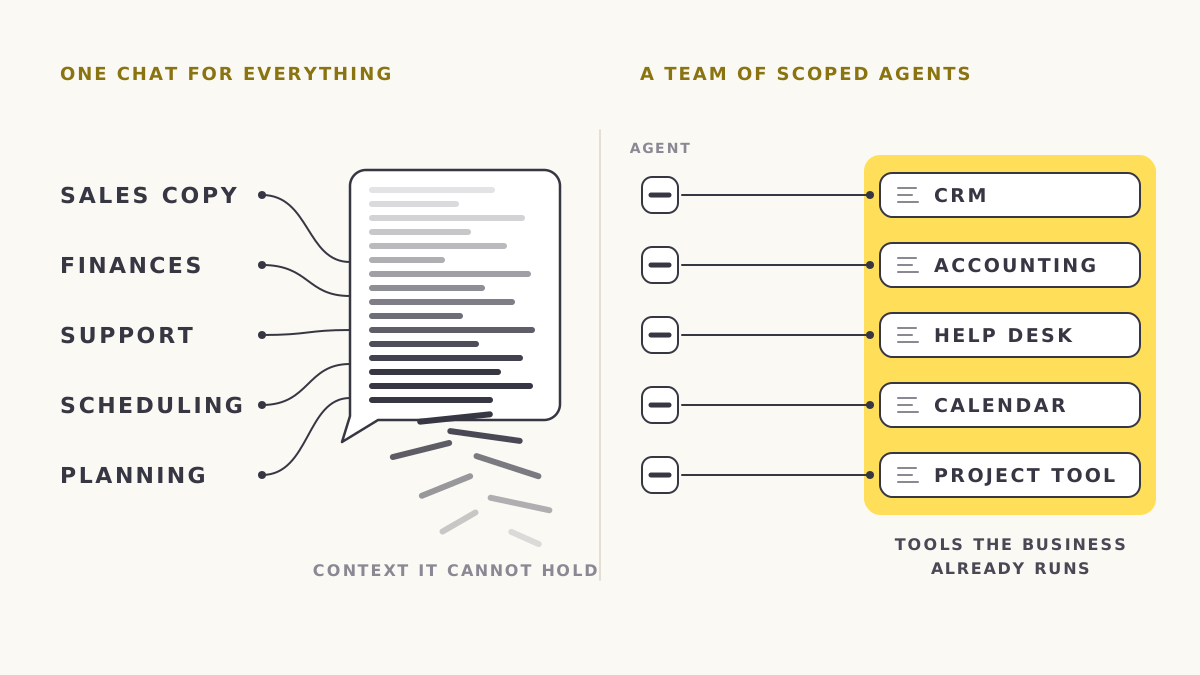
Take the "Business" thread from the top of this piece and list what it was doing: drafting and chasing quotes, confirming bookings, reminding late payers, answering the occasional question about the month's numbers, writing the odd social post, and once, a question about how to handle an employee's leave. Six jobs, one window, no tools. Here is how that splits.
Quote follow-up. One agent, one job: find quotes that went out and got no answer past the cadence you set, and send the follow-up your written procedure describes. Its tools are the job or CRM tool where quotes live, that procedure, and email. It never invents a price, because it reads the quote that was actually sent. Its owner is whoever runs sales, and for the first weeks every message goes out only after that person approves it.
Invoice reminders. A second agent reads the accounting software for what is overdue and the bank feed for what has landed, so it never chases someone who paid yesterday. Its tool set is those two plus your payment-terms document. It drafts and you send, until you are ready to let it send within limits you set. Money never moves on an agent's say-so. That line does not move.
Scheduling. A third agent reads the calendar and the job board and proposes slots or confirmations. Its scope is the calendar. It has no idea what anyone owes you, and it does not need to.
What is left: the monthly numbers question is a real job and a good fourth agent later, once the accounting connection exists and has earned some trust. The social posts get their own thread. The leave question stays with a human, because it is judgment about a person, and judgment is the last thing you delegate.
Each agent now has one scope, a couple of tools, one owner. When one is wrong, you know which one and what it read. The thread that did everything could never tell you that.
Model limit or overload? How to tell
Two different problems produce the same wrong answer, and they have different fixes, so it is worth telling them apart. The test costs you a few minutes.
Rerun it clean. Open a fresh chat. Paste only the facts the question needs, current as of today, and ask again. If the answer is now right, the model was never the problem. The thread was. That is overload, and the fix is scope and tools, not a different model.
Trace the wrong fact. Ask where the wrong detail could have come from. If it was never in the conversation and never in any tool the model could reach, it could not have known it, and it filled the gap. The fix is a source: connect the tool that holds the truth. If it was in the thread but far back, the window moved past it. Same fix. If it was recent, correct, in plain view, and the model still got it wrong, you are closer to a real limit, or to an instruction that told it two things at once. Reread your own instructions before you blame the model.
Know the real limits. Some failures are the model's, and no amount of scoping fixes them. Arithmetic across a long list of numbers. Events after its training ended. Specialized legal or tax judgment. A blurry photo of a handwritten note. For these the fix is a tool built for the task, or a person, not a better prompt. A calculator does not hallucinate. Neither does your accountant, at least not about your books.
What to write down before building anything
Every fix above assumes there is something to point the agent at. In most small businesses, part of it does not exist yet. It lives in the owner's head. So the first work is not technical. It is writing.
The jobs. Every distinct thing your chat has been doing, as verbs. Chase quotes. Confirm bookings. Remind late payers. If the list runs past a handful, that is the diagnosis.
Where the truth lives today. For each job, the tool that holds its facts: the bank, the calendar, the job board, the accounting software, a spreadsheet, or a person. Wherever the answer is "a person", you have found the first thing to document.
What good looks like. One sentence per job that someone can check the output against in under a minute. "The reminder names the right invoice and the right amount, and goes only to people who have not paid."
Who checks, and what never goes out without them. A name, not a role. And the short list of things the agent never does alone: move money, sign anything, promise a date to a customer, change a price. No owner, no agent.
The process as it actually runs. Exceptions included. The template, the checklist, the thread that shows how it is done today. If the only copy is in someone's head, writing it down is the whole first week, and it is worth the week even if no agent is ever built.
This is where our own engagement starts, and it is why the first thing Holybiz does with a company is not build an agent. We map the business as it actually operates: the processes, who runs them, where the information lives, where the rework is. Then agents get built by scope, one job each, wired into the tools the business already runs, so the facts stay in the systems that own them instead of inside one agent's shifting sense of a conversation. We run our own companies this way, including the site you are reading. The agents will still be wrong sometimes. The difference is that you will be able to see what they read, fix the source, and move on.
Hallucination is usually a symptom of overload, not a defect in the model.
A long chat has an edge. Past it, earlier decisions are not forgotten, they are simply no longer in front of the model.
People do not memorize everything either. They open the bank, the calendar, the accounting software. Agents need the same access.
One job, a couple of tools, one named owner per agent. When it is wrong, you can see what it read.
Rerun the question in a clean chat with current facts. If it is right now, the thread was the problem, not the model.
Map the jobs and where their facts live before building anything. If the answer is "in someone's head", start there.
Read next

Customers pay more to the company that looks like it knows what it is doing
A fast first reply, a visit with a checklist, a complete proposal, a short presentation and two follow-ups are not good manners. They are how a customer who cannot judge your work decides what it is worth, and the margin follows that judgment. The research on how people read price, design and trust, and what winning proposals actually contain.
 Patricia de Castro Araujo·Oct 3, 2026
Your week has forty hours of work in it and sixty hours of business
Answering the phone, keeping the feed alive, finding a slot for an estimate, writing the quote, chasing the invoice. None of it is the job the customer pays for, and it is where most of a small-business owner's week goes. What the surveys actually measured, where the government data disagrees with the vendors, and which bucket to hand over first.
Patricia de Castro Araujo·Sep 26, 2026
The customer called while you were on the roof. Nobody answered.
Every service owner I interview tells me the same three stories: the reply that came too late, the quote that went out too late, the day lost confirming what was already agreed. Here is what the sources actually say those three hours cost, which famous numbers I refused to use, and why a company with seventy salespeople bleeds in exactly the same place.
Patricia de Castro Araujo·Sep 19, 2026