
Can AI write your value proposition?


In this article
No. A model can write the sentence, and it will write a good one, but a value proposition is a decision about who you are for and who you are not for, and that decision cannot be outsourced to something that has never met your customers or carried your costs. The risk is new and specific: fluent copy used to be weak evidence that someone had thought it through, and now it is no evidence at all, so a business can ship a promise nobody inside it can keep. Use a model the way you would use a demanding interviewer: to interrogate your answer, to name who your sentence excludes, to show you which competitors could say the same words. Then make the call yourself, and check whether the person who delivers the work can actually keep the promise.
Answer fast, out loud, without editing: what is the value proposition of your product or service?
I have been asking business owners that question for more than a decade, in consulting rooms and workshops, and the answers arrive in a small number of shapes. A price. A list of features. An adjective that could belong to anyone, usually "quality" or "good service". Sometimes a genuinely good answer, and you can always tell, because a good answer is specific enough to exclude someone.
Patricia made this same argument six years ago, on the blog of Pitada Criativa, the consultancy we started together in 2012 and which she took back up in 2019. Her argument still holds: a value proposition is not the estimate you send the client. It is a promise the customer has to perceive before, during and after buying, and when it is clear, it shows up in every part of the operation, not just the marketing.
What has changed since is not the argument. It is that the words got free.
Fluency stopped being a signal
Six years ago, if a small business had a sharply written homepage, that was weak but real evidence that someone had sat down and thought hard about what they were selling. Writing well was expensive. It took a person, and that person had to ask uncomfortable questions to do the job.
That evidence is now worthless. Any business can have fluent, confident, professionally cadenced copy in about ninety seconds, and most of them do. Which means the market got quieter in a strange way: everybody sounds clear, so sounding clear tells your customer nothing. Being genuinely differentiated became more valuable at the exact moment it became harder to see.
There is a second, sharper problem, and I have watched it happen to real businesses this year.
An owner asks a model for their value proposition. The model, having no way to know, produces something plausible: a warm sentence about personalized attention and lasting partnerships. It reads well. It goes on the site. And now the business is publicly promising something nobody inside it ever decided to deliver, so the promise fails at the first point of contact, where the customer meets the actual work. That is worse than a vague homepage. A vague homepage does not create expectations it cannot meet.
A value proposition is not a sentence you write. It is a decision you make, which you then write down. Skip the decision and the sentence becomes a liability.
What I learned selling something nobody had asked for
When we started Sizebay in 2014, we built a virtual fitting room for fashion e-commerce. I led the market analysis, the product conception and validation, the brand, the first team, the first investors and the software patent, and over the following years it reached more than a thousand e-commerce clients in more than fifty countries, with operations in Brazil, Portugal and the United States.
For a long stretch at the beginning, I described what we sold badly. I described the technology, because the technology was genuinely hard and I was proud of it. It did not work. What the customer was actually buying was not a fitting room. It was the removal of a specific doubt at a specific second: the moment a shopper stares at a size chart and decides not to risk it. The retailer was buying fewer returns and fewer abandoned carts. Same product, completely different sentence, and only the second one sold.
Then we went to Portugal, and later to the United States, and I had to make that decision again, because the same product was worth something different in each market and to each kind of retailer. That is the part people miss about value propositions: it is not a branding exercise you complete once. It is a decision you keep making as the business meets new reality.
I also spent years accredited as a SEBRAE consultant, running this exercise with hundreds of small companies. The pattern was consistent. The owners who could not answer the question were almost never lazy or unintelligent. They were too close to the work, and nobody had ever made them choose.
The exercise, as I actually run it
Five questions, in this order. Do not skip to the writing.
Who is this not for? Start here, because it is the hardest and it does most of the work. A proposition that excludes nobody promises nothing. If you cannot name a type of customer you would turn away, or send to a competitor, you do not have a position yet, you have a hope of universal appeal.
What does your customer stop doing, feeling or risking? Not what you provide. What disappears from their week. Features describe you; this describes them.
What would they actually lose if you closed tomorrow? If the honest answer is "they would call the next company on the list", that is useful information, not an insult. It tells you the value is in the category, not in you, and that is a business decision to face rather than a sentence to write around.
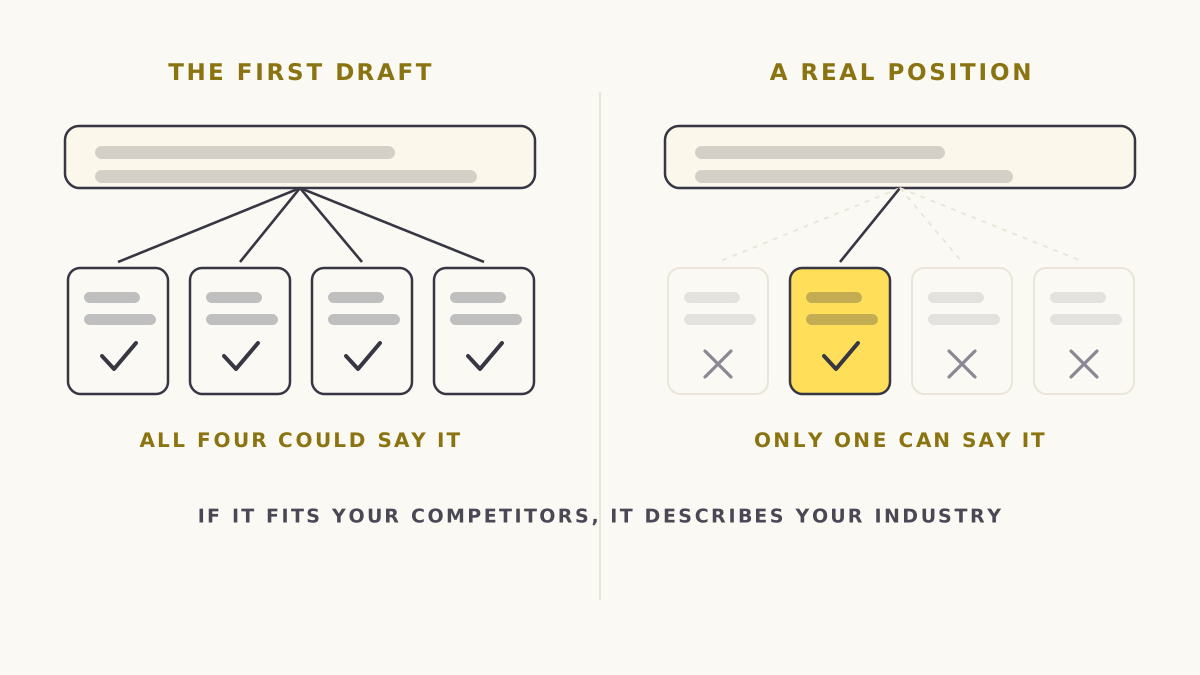
Which of your competitors could say your exact sentence? Write it, then read it as if it were on three competitors' sites. If it fits all of them, it is a description of your industry, not of you. This is the test almost everyone fails on the first attempt, including me at Sizebay.
Can the person doing the work keep this promise on a bad Tuesday? Not on your best day. On an understaffed one. A proposition the operation cannot honour is not positioning, it is a complaint waiting to be written.
Where a model genuinely helps
I use AI in this work every week, so let me be precise about where it earns its place. Not as the author. As the interviewer, the adversary and the mirror.
As an interviewer that never gets tired. Give it what you do, ask it to interrogate you for twenty minutes about who you are not for, and refuse to let yourself answer in adjectives. A good consultant does this. A model will do it at eleven at night, for as long as you can stand it.
As an adversary. Paste your draft and ask it to write the ten competitors who could truthfully claim the same sentence. This is the fastest version of question four I have found, and it is brutal in a useful way.
As a mirror. Ask it what promise a stranger would infer from your site, then compare that to the promise you meant to make. The gap between the two is usually the most honest audit a small business will get for free.
As a translator, at the end. Once the decision is yours and it is real, a model is very good at saying it in three languages, at different lengths, for different audiences. That is a genuine acceleration, and it is the only part of this where it should hold the pen.
What it cannot do is know that you turn down the wrong kind of client, or that your best work happens when the customer is already halfway into a mess, or that half your revenue comes from one referral source you have never written down. It has never sat in your operation. It will not tell you it does not know. It will produce something plausible, because that is what it does when it has nothing to check against.
What this has to do with Holybiz
This is the first thing we ask in an engagement, before any conversation about agents, tools or automation. Not because it is a nice warm-up. Because everything downstream inherits it: an agent that answers customers is repeating your value proposition all day long, at scale, without judgment, and it will repeat a vague one just as tirelessly as a clear one.
Automating an unclear promise does not clarify it. It just distributes it faster.
Fluent copy used to be weak evidence that someone had done the thinking. Now it is no evidence at all, for you or for your competitors.
The new failure mode is specific: a model writes a plausible promise, it goes live, and the business publicly commits to something nobody inside it decided to deliver.
Start with who you are not for. A proposition that excludes nobody promises nothing.
The test most first drafts fail: if three competitors could put your sentence on their site without lying, you have described your industry, not your business.
Use a model as interviewer, adversary and mirror, and let it hold the pen only after the decision is genuinely yours.
An agent talking to customers repeats your value proposition all day. Automating a vague one only distributes it faster.
Read next

Customers pay more to the company that looks like it knows what it is doing
A fast first reply, a visit with a checklist, a complete proposal, a short presentation and two follow-ups are not good manners. They are how a customer who cannot judge your work decides what it is worth, and the margin follows that judgment. The research on how people read price, design and trust, and what winning proposals actually contain.
 Patricia de Castro Araujo·Oct 3, 2026
Your week has forty hours of work in it and sixty hours of business
Answering the phone, keeping the feed alive, finding a slot for an estimate, writing the quote, chasing the invoice. None of it is the job the customer pays for, and it is where most of a small-business owner's week goes. What the surveys actually measured, where the government data disagrees with the vendors, and which bucket to hand over first.
Patricia de Castro Araujo·Sep 26, 2026
The customer called while you were on the roof. Nobody answered.
Every service owner I interview tells me the same three stories: the reply that came too late, the quote that went out too late, the day lost confirming what was already agreed. Here is what the sources actually say those three hours cost, which famous numbers I refused to use, and why a company with seventy salespeople bleeds in exactly the same place.
Patricia de Castro Araujo·Sep 19, 2026