
The business you lose while you are busy working


In this article
You are not losing business to a competitor who is better than you. You are losing it in the hours when nobody could answer. An audit of 2,241 US companies found that 23% never responded to a web lead at all, and that the average among those that did was 42 hours. Firms that tried to reach the customer within an hour were nearly seven times as likely to qualify the lead as those that waited one hour more. In home services, 97% of US homeowners say response time influences who they hire, and 9% of recent homebuyers say a provider never replied to them at all. The quote and the appointment leak the same way: 42% of those homebuyers say the single most important thing they wanted before hiring was clear pricing or a written estimate, and proposals sent within a day of the conversation convert better and sign in five days instead of thirteen. The owner cannot be on the roof and at the phone. The fix is to stop making the first hour depend on the owner.
The lead came in at nine at night. You were on a roof with the phone in the truck, or in a crawl space, or with a customer who was paying you for your attention. You called back the next day at two, polite and too late, because by then they had a quote from whoever answered at a quarter past nine.
I have heard that story in three versions from hundreds of small businesses since I started interviewing their owners in 2019. I heard it before that, from the other side, at Tupy, where I managed the commercial portfolio for the domestic and export markets and built the systems the sale ran through. And I lived it at Sizebay, where from 2014 I validated the sales model by making the sales myself before I supported two other people doing it.
The three versions are always the same three. The reply that came late. The quote that went out late. The day that disappeared into calls confirming what was already agreed. Nobody counts them, because each one looks like a small thing that happened once. This article is my attempt to count them, with sources, and to tell you honestly where the sources stop.
The late reply, in numbers
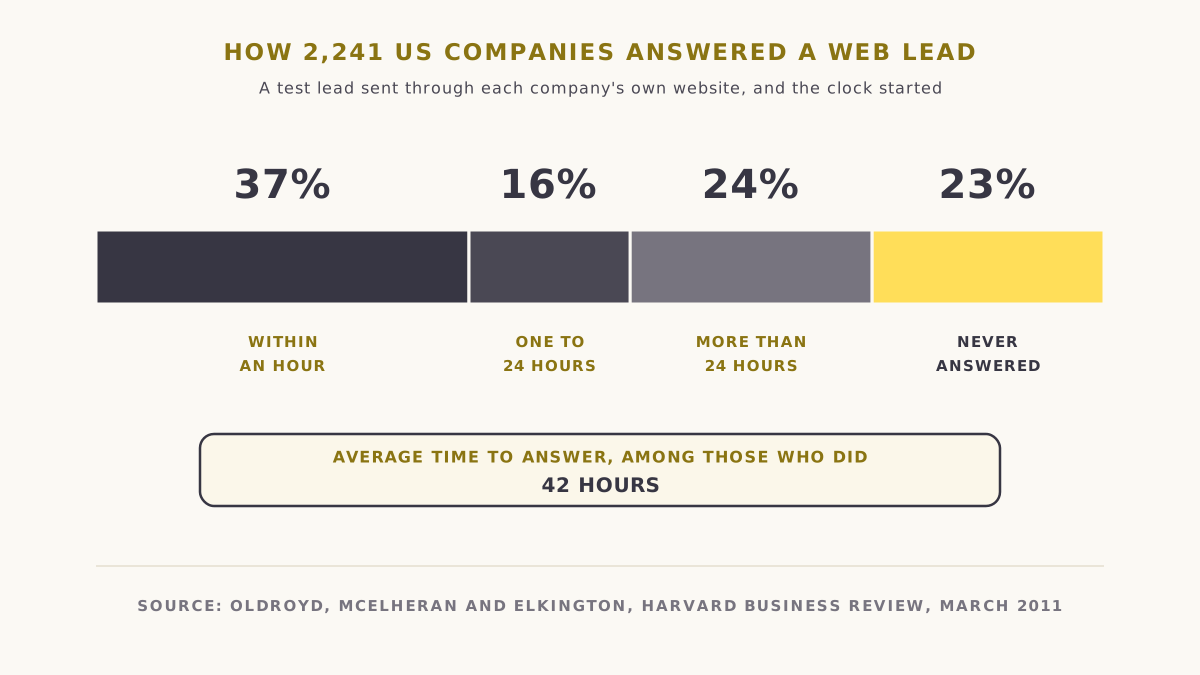
The best audit I know of is the one Harvard Business Review published in 2011, by James Oldroyd, Kristina McElheran and David Elkington, under the title The Short Life of Online Sales Leads. They sent a test lead through the website of 2,241 US companies and timed the answer. 37% responded within an hour. 16% took between one and 24 hours. 24% took more than a day. And 23% never responded at all. Among the companies that did answer within thirty days, the average response time was 42 hours.
The same authors ran a second study on 1.25 million leads received by 42 US companies. Firms that tried to contact the customer within an hour of the inquiry were nearly seven times as likely to qualify the lead, which they defined as having a meaningful conversation with the decision maker, as firms that tried even one hour later. Against companies that waited a day or more, the ratio was more than sixty to one.
An earlier study by Oldroyd with InsideSales.com, on three years of data from six companies, over fifteen thousand leads and over a hundred thousand call attempts, went down to the minute: the odds of qualifying a prospect fell 21-fold when the response stretched from five minutes to thirty. Two honest caveats. That study was paid for by a company that sells speed, and it measured contacting and qualifying, never closing. The authors say so themselves. Keep that in mind every time someone turns these numbers into revenue.
What about your customers, the ones with a leaking faucet rather than a software budget? Housecall Pro surveyed 1,040 US homeowners in October 2025 and 97% said response time influences who they hire. Jobber surveyed 1,050 US home-service owners in December 2025 and asked them what their customers expect: 28% said an immediate response and another 28% said within the hour. In the same survey, 20% of the owners said they reply within the hour. In HVAC, 11%. Those are owners describing their own customers and themselves, not a customer survey, which is why I pair them with one: of 800 recent US homebuyers Jobber asked in May 2026, 15% had to chase a provider repeatedly and 9% never received a response at all.
Nine percent is not a rounding error. It is one customer in eleven who raised their hand and heard nothing.
The late quote
The visit went well. Then the quote took three evenings, because the photos were on your phone, the price list was in your head, and the kitchen table was the only office you had after eight. The customer took the silence as an answer.
Of those same 800 recent homebuyers, 42% said the single most important thing they wanted before hiring was clear, upfront pricing or a written estimate. Nothing else came close. In Housecall Pro's survey, 93% said an instant estimate influences their decision, 77% named hidden or surprise costs as a top frustration, and 80% wanted to see what options were available.
Speed matters inside the quote stage too, and here the only data I could find comes from the companies that sell proposal software, so read it as their platform's numbers. Better Proposals, from four years of closed deals on its system, reports that proposals sent within 24 hours of talking to the client convert 23% better, and that they were signed in five days on average against thirteen when the proposal waited three or four days. Proposify, from 742,137 proposals sent through its platform in 2025, reports an average of 17 minutes to create a proposal, 34 minutes until the customer opens it, and 2.5 days from that opening to a signed deal.
Seventeen minutes. The quote that costs you three evenings costs a company with a template and a price list the length of a coffee break. That gap is not talent. It is preparation, and I will come back to it.
The lost day
The third story has no famous statistic, and I am not going to invent one. It is the call to confirm Tuesday, the call to move Tuesday to Thursday, the call to remind them anyway, each landing while you are holding a tool. It is the estimate you could not schedule for ten days because your calendar lives in your head and the customer's lives in theirs.
What I can show you is what the customer wants at that moment. In Housecall Pro's survey, 80% of homeowners said online booking influences who they hire. In Scorpion's survey of 2,000 US homeowners in late 2025, 56% wanted 24/7 scheduling or a way to communicate after hours. And on the other side of the counter, in Jobber's owner survey, 14% of pros said they value online booking. Eighty against fourteen. That is the gap the lost day lives in.
The numbers I refused to use
You have seen the others. "62% of calls to small businesses go unanswered." "85% of people who cannot reach you will never call back." "80% of sales require five follow-ups, and 44% of salespeople give up after one." "78% of homeowners hire the first contractor who responds."
I went looking for each one and I am not printing any of them. The 62% is credited to a 2014 study whose page no longer contains it, dated three different ways by the people who quote it. The 85% is attributed to a research firm whose report nobody names. The five follow-ups and the 44% are credited to a National Sales Executive Association that does not exist; the closest real ancestor is a 1942 survey of fewer than forty members of one Long Island chapter. The 78% appears on marketing blogs and on none of the surveys they attribute it to.
They may all be roughly true. I do not know that they are, and a number I cannot show you the origin of is not evidence. It is decoration.
This is not a small-business disease
Here is the part that surprised me when I first read the audit. The 2,241 companies were not one-person plumbing shops. They were in financial services, automobiles, education, software and health care, with sales forces and CRM systems and marketing budgets, and a quarter of them still never answered. The authors list the reasons, and they are organizational, not technical: leads pulled from the CRM once a day instead of continuously, salespeople busy generating their own leads instead of reacting to customers who were already asking, and rules for distributing leads among agents by territory and fairness.
The pattern has not aged. In 2017 Drift filled in the demo form of 433 B2B software companies: 7% responded within five minutes, and 55% had not responded after five business days. In March 2026 Workato did the same with 114 B2B companies: more than 99% did not respond within five minutes, and the average email reply took eleven hours and fifty-four minutes. Both tests were run by companies selling a cure, so treat them as the symptom, not the dose.
And the people who should be answering are not answering because they are busy with something else. Salesforce's survey of 7,775 sales professionals in 2022 found that reps spend just 28% of their time selling. Its 2026 edition, from 4,050 sales professionals in 22 countries, says they spend more than half of their time on nonselling work like data entry and prospecting.
So a company with seventy salespeople has the same hole you have. The difference is who is standing in it. The Small Business Administration counts 36,207,130 small businesses in the United States, and 82.3% of them have no employees. In a large company the gap is a process nobody owns. In yours, the gap is you, on the roof.
What I would do this week
None of this needs software you do not have. It needs three numbers and a decision.
Measure your own three hours. For the last thirty days: how long from the first contact to your first reply, how long from the visit to the quote, how long from the quote to a confirmed date. Use the real messages, not your memory. Most owners who do this find a number they would not have believed.
Pick a standard you can keep. Not "as fast as possible". A reply within fifteen minutes during working hours and within the hour outside them. A quote the same day as the visit. A date offered in the first reply, not after three calls.
Write the first reply on paper. One paragraph, with a real name, a time, and the same three qualifying questions. I wrote about what it has to contain and what it must never say, and that article is still the specification.
Turn the quote into a template with a price list. The seventeen minutes come from having the structure before the visit, not from typing faster. Every quote has the same sections; only the numbers change.
Make your calendar visible before you automate anything. Two or three slots a day that exist for estimates, written where someone other than you can see them. A calendar in your head cannot be booked by anyone else, including an agent.
Then hand the first hour over. The first reply, the draft of the quote from your price list, the follow-up on day two and day five. This is the one part of selling with no judgment in it, which is why I put it at the top of the funnel and nowhere else.
What this has to do with Holybiz
The first agents we build with an owner do exactly the three things above, and nothing more ambitious. They answer in minutes, in English or Spanish, ask the same questions and keep the lead warm until you can look. They draft the quote from your price list the same day and wait for your yes before anything goes out. They follow up on day two and day five. Booking from your calendar and the reminder the day before are being built, and I would rather tell you that than promise them.
What changes in the first month is rarely the revenue. It is that the nine percent who never heard back becomes zero, and that you finally know your three numbers.
You lose business in the hours when nobody could answer, not to a better competitor. In the 2011 HBR audit of 2,241 US companies, 23% never answered a web lead and the average was 42 hours.
Speed changes the odds, not the deal: within an hour, nearly seven times as likely to qualify the lead; from five minutes to thirty, the odds of qualifying fell 21-fold. Those studies measured conversations, never closed sales.
Your customers say so themselves: 97% of US homeowners say response time influences who they hire, and 9% of recent homebuyers never got a reply from a provider at all.
The quote leaks the same way. 42% of recent homebuyers wanted clear pricing or a written estimate above everything else, and proposal platforms report that a quote sent within 24 hours converts better and signs in five days instead of thirteen.
Large companies have the same hole: 7% of 433 B2B companies answered a demo request within five minutes, and sales reps spend 28% of their time selling. The difference is that in a small business the person standing in the gap is you.
The famous numbers (62% unanswered, 85% never call back, five follow-ups, 78% hire the first responder) could not be traced to a primary source, so they are not in this article.
Measure your three hours, pick a standard you can keep, write the first reply and the quote template, make the calendar visible, and only then hand the first hour to an agent.
Read next

Customers pay more to the company that looks like it knows what it is doing
A fast first reply, a visit with a checklist, a complete proposal, a short presentation and two follow-ups are not good manners. They are how a customer who cannot judge your work decides what it is worth, and the margin follows that judgment. The research on how people read price, design and trust, and what winning proposals actually contain.
Patricia de Castro Araujo·Oct 3, 2026
Your week has forty hours of work in it and sixty hours of business
Answering the phone, keeping the feed alive, finding a slot for an estimate, writing the quote, chasing the invoice. None of it is the job the customer pays for, and it is where most of a small-business owner's week goes. What the surveys actually measured, where the government data disagrees with the vendors, and which bucket to hand over first.
Patricia de Castro Araujo·Sep 26, 2026
Agents don't hallucinate on their own, they get overloaded
Agents rarely hallucinate because the model is broken. They hallucinate because one chat was asked to be memory, filing cabinet and five specialists at once.
 Janderson Araujo·Sep 5, 2026