
The art of the commercial approach


In this article
A customer who cannot judge your work before buying it judges everything around it: how fast you replied, how the visit felt, what the proposal looked like, whether you followed up. That is not vanity. It is how people decide under uncertainty, and the research is consistent: the look of a thing drives credibility judgments, price itself is read as a signal of quality, and 80% of customers say the experience a company provides matters as much as what it sells. The arithmetic makes it worth the trouble. For a company with average economics, a 1% improvement in price is worth 11.1% of operating profit, more than three times what 1% more volume brings. So the commercial approach is five moves, done the same way every time: the first reply in minutes, the visit with a written checklist, a complete and structured proposal sent the same day, a presentation of it rather than a send-and-wait, and a follow-up on day two and day five. Every move says the same thing to the customer: this company is organized. Organized is what people pay more for.
At Tupy I managed the commercial portfolio for the domestic and export markets, and I built the systems the sale ran through, from the order to the invoice to the export papers. At Sizebay, from 2014, I validated the sales model by making the sales myself, then supported two other people making them. Since 2019 I have interviewed the owners of hundreds of small businesses about how they sell.
In all of that, one thing has stayed true across foundries, software and plumbing. The companies that charged more were rarely the ones with the best work. They were the ones whose customers never had a reason to doubt them.
This article is about how that doubt is created or removed, with the sources I could verify and a note on the ones I could not.
What the customer actually sees
Picture the customer's kitchen table. Two quotes for the same job. One is a folded sheet with a coffee ring, a number and a phone number. The other is a short document with your name on the cover, what you understood of the problem, what you will do, what it costs with two options, when you can start, and a line for a signature.

The customer cannot see the work yet. They can see this, and they decide from it. We have known how that works for more than twenty years. In 2002 the Stanford Persuasive Technology Lab asked 2,684 people to compare websites and explain which one they found credible; the design look of the site was the thing mentioned most, present in 46.1% of the comments, ahead of how the information was organized. The lab's guidelines, from three years of research with over 4,500 people, say it without hedging: people quickly evaluate a site by visual design alone. The other guidelines read like a list for a proposal: show that there is a real organization behind it, make it easy to contact you, avoid errors of all types no matter how small.
That research was about websites. I have never seen a reason to believe a quote on a kitchen table is read differently.
Why the organized one gets the higher price
Two separate lines of research explain the margin, and neither of them is about being pushy.
The first is that price is read as information. Akshay Rao and Kent Monroe reviewed the experimental literature in 1989 and found that the effect of price on perceived quality is moderately large and statistically significant, larger than the effect of the store a product is sold in. Nearly twenty years later a team at Caltech and Stanford put twenty people in a brain scanner and gave them the same wine labelled at two prices; the higher price raised both the reported pleasantness and the activity of the brain region that encodes it. A small study, and wine is not roofing. But the mechanism is the one you sell against every day: a customer with no way to test the work reads your price as part of the evidence. A price that looks apologetic says something about the work.
The second is that the experience around the work counts as the work. In Salesforce's survey of 11,000 consumers and 3,300 business buyers across 25 countries, 80% said the experience a company provides is as important as its products and services; the year before, with a larger sample, it was 88%. Closer to your customer: Housecall Pro asked 1,040 US homeowners in October 2025 and 72% said they would pay 10% more for a pro with a better customer service reputation, and 97% said transparent pricing matters when hiring. Deloitte, from more than 200,000 survey responses across nearly 500 brands, reports that customers who trust a brand are 88% more likely to buy again.
None of these is a controlled experiment on your market, and they are mostly vendor surveys of stated preferences. Read them together, though, and the direction is not in doubt. Trust is bought with the parts of the sale the customer can see, and trust is what lets a price stand.
The arithmetic of margin
Here is why this is worth more of your attention than one more lead. In 1992 two McKinsey consultants published in Harvard Business Review the average economics of 2,463 US public companies. A 1% improvement in price, with no loss of volume, increased operating profit by 11.1%. A 1% improvement in volume, at the same price, brought 3.3%. Price moved profit three to four times harder than volume, and a 1% discount destroyed the same 11.1%. The firm repeated the exercise in 2003 on the S&P 1500 and found 8% of operating profit for each 1% of price; to make up for a 5% price cut, volume had to rise 18.7%.
That is large-company arithmetic, and your margins are not theirs. The direction, though, holds for anyone with costs: the 5% you knock off to look friendly on the kitchen table is not 5% of your profit. It is a great deal more, and you will spend weeks of extra jobs earning it back.
The approach, in five moves
The approach is a sequence, and its power is in being the same every time. A customer who sees the same shape at every step concludes that the shape exists, which is another way of saying they conclude you are organized.
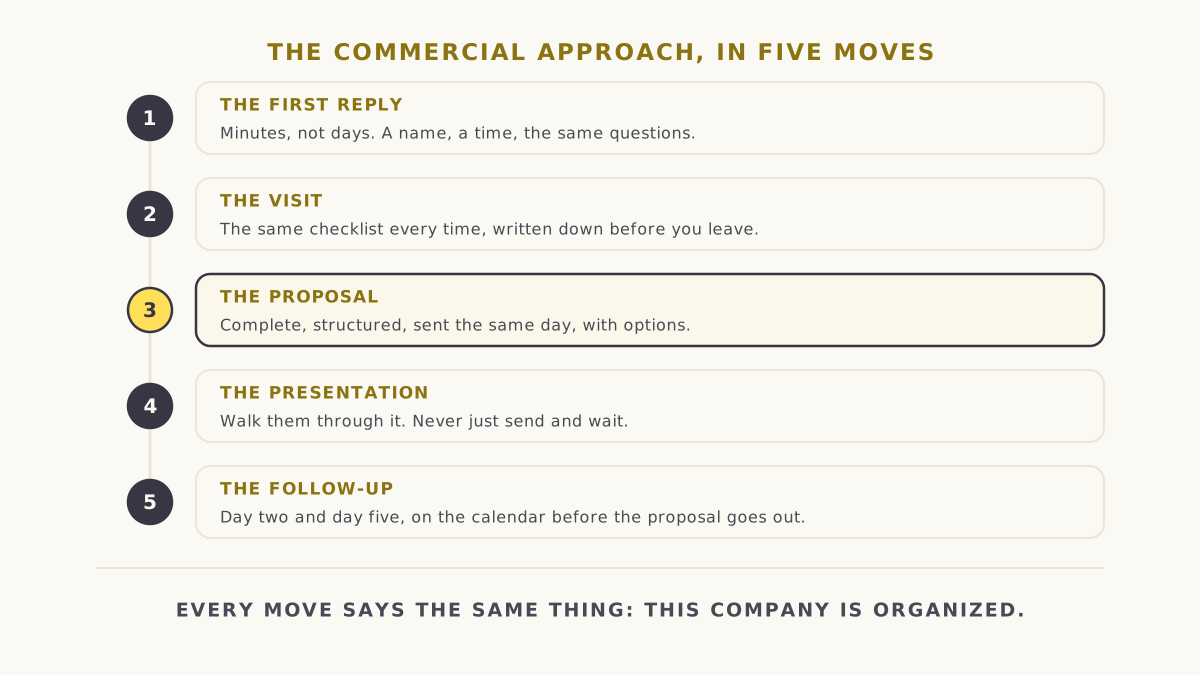
The first reply, in minutes. A name, a time, the same three questions. I have written the whole specification and will not repeat it here, except to say what speed buys: in the Lead Response Management study of fifteen thousand leads, the odds of qualifying a prospect fell 21-fold when the response stretched from five minutes to thirty. The first reply also sets the tone for everything after it. A customer who was answered in four minutes expects the quote to be on time, and notices when it is.
The visit, with a written checklist. The same questions in the same order, the measurements the quote will need, photos named by room, and one question most owners skip: what would make this a success for you. Write the answers before you leave the driveway. The checklist is what makes the seventeen-minute proposal possible, and it is what makes two visits by two people in your company look like one company. Gartner found that 69% of business buyers report inconsistencies between what a company's website says and what its sellers tell them. A checklist is the cheapest consistency there is.
The proposal: complete, structured, the same day, with options. This is the center of the approach. Proposify analyzed 742,137 proposals sent through its platform in 2025 and listed the sections that appear most often in the ones that won: a cover page, a summary of what was understood, the approach and scope, deliverables and timeline, who you are, the pricing, terms and a place to sign. Winning proposals averaged eleven pages against thirteen for losing ones, so complete does not mean long. 83% of the winners included images. Proposals with an electronic signature closed 15% more often and 60% faster. And proposals with interactive pricing, where the customer can choose between options, won twice as often. That last point matters most for a service business and is the least used: in Jobber's survey of over a thousand US home-service owners, only 16% offer tiered good, better and best options, while in Housecall Pro's survey 80% of homeowners wanted to see what options were available. Options turn the question from whether to hire you into which version to pick, and they let the customer raise the price themselves. On speed, the only data comes from proposal vendors, so take it as their platform's numbers: Better Proposals reports that proposals sent within 24 hours of the conversation convert 23% better and sign in five days instead of thirteen. On a platform with a template, Proposify's average time to create one was seventeen minutes.
The presentation, not a send-and-wait. Walk the customer through it, in person or in ten minutes on the phone, before they read it alone. This is where you answer the question they have not asked, usually about the cheaper option they are quietly comparing you to. Buyers decide more alone than sellers like to think: in a study of 1,500 business buyers, the average customer had completed 57% of the purchase decision before talking to a sales rep, and in Gartner's 2025 survey 61% said they would rather buy without one at all. The presentation is not a pitch. It is the part of the decision you are allowed into, and the proposal is what earns you the invitation.
The follow-up, on day two and day five, decided before the proposal goes out. Not "just checking in". A specific question on day two (did the timeline work for you) and a specific offer on day five (I can hold the start date until Friday). The effect of simply sending a second message is large wherever it has been measured. Backlinko analyzed 12 million outreach emails, which were link-building and PR requests rather than sales quotes, and found that one follow-up produced 65.8% more replies than a single message. And customers watch how you follow up in public too: in BrightLocal's 2026 survey of 1,002 US consumers, 80% said they are likely to use a business that responds to all its reviews, and 42% said they are unlikely to use one that never replies.
The numbers I did not use
There are three famous figures I wanted for this article and left out. PwC's finding that customers will pay a premium of up to 16% for a great experience, Edelman's finding that trust is a deciding factor for 81% of buyers, and Gartner's finding that buyers spend only 17% of their time with suppliers. All three may be exactly right. I could not open the primary page of any of them from where I was working, only other people's copies of the number, and a figure I cannot show you the origin of does not go in your hands. If I can open the page, it goes in the next edition.
What I would do this week
Write the proposal template once. Seven sections, in the order above. Every job you sell from now on fills the same shape, and the shape is most of the message.
Build the price list with three options for your five most common jobs. Good, better, best. Put the one you want to sell in the middle. If you only ever quote one number, you are letting the customer compare you to a stranger instead of to yourself.
Pre-write the two follow-ups. A question for day two, an offer for day five. Put them in the calendar before you send the proposal, not after you notice the silence.
Adopt one rule for the presentation. You do not send a proposal without a time to walk through it. If they will not give you ten minutes, you have learned something about the deal before writing it.
Fix the first reply. It is the first thing the customer sees of the shape, and it is the only move that can be done without you.
Stop discounting to look friendly. Say the number, then be quiet. One percent of price is eleven percent of profit for an average company. Your figure is different, and it is still not small.
What this has to do with Holybiz
Three of the five moves can be done for you, and two cannot. The agents we install answer in minutes, draft the quote from your price list and your visit checklist the same day, wait for your yes before anything goes out, and send the day-two and day-five follow-ups you wrote. The visit and the presentation stay yours, because that is where the judgment is and that is where the customer wants you. An agent will never decide a price exception. It will make sure the proposal that carries your price looks like the company you are trying to be.
A customer who cannot judge the work judges everything around it. In Stanford's study of 2,684 people, the look of a site was the most-mentioned reason for finding it credible, and the lab's guidelines say people evaluate by design alone.
Price is read as quality (Rao and Monroe, 1989) and the experience counts as the product for 80% of customers (Salesforce, 2023). 72% of US homeowners say they would pay 10% more for a pro with a better service reputation.
The arithmetic: for an average company, 1% of price is worth 11.1% of operating profit, against 3.3% for 1% of volume. A friendly discount costs far more than it looks.
Five moves, the same every time: the first reply in minutes, the visit with a checklist, a complete proposal with options sent the same day, a presentation rather than a send-and-wait, and follow-ups on day two and day five.
Winning proposals in Proposify's 742,137 are complete but not long (eleven pages against thirteen), include images, carry an e-signature, and offer options, which win twice as often. Only 16% of home-service pros offer options.
Three famous figures (PwC's 16% premium, Edelman's 81%, Gartner's 17%) are not here because I could not open their primary source.
Three of the five moves can be handed to an agent. The visit and the presentation cannot, and should not.
Read next

Your week has forty hours of work in it and sixty hours of business
Answering the phone, keeping the feed alive, finding a slot for an estimate, writing the quote, chasing the invoice. None of it is the job the customer pays for, and it is where most of a small-business owner's week goes. What the surveys actually measured, where the government data disagrees with the vendors, and which bucket to hand over first.
Patricia de Castro Araujo·Sep 26, 2026
The customer called while you were on the roof. Nobody answered.
Every service owner I interview tells me the same three stories: the reply that came too late, the quote that went out too late, the day lost confirming what was already agreed. Here is what the sources actually say those three hours cost, which famous numbers I refused to use, and why a company with seventy salespeople bleeds in exactly the same place.
Patricia de Castro Araujo·Sep 19, 2026
Agents don't hallucinate on their own, they get overloaded
Agents rarely hallucinate because the model is broken. They hallucinate because one chat was asked to be memory, filing cabinet and five specialists at once.
 Janderson Araujo·Sep 5, 2026