
The hours that do not make money


In this article
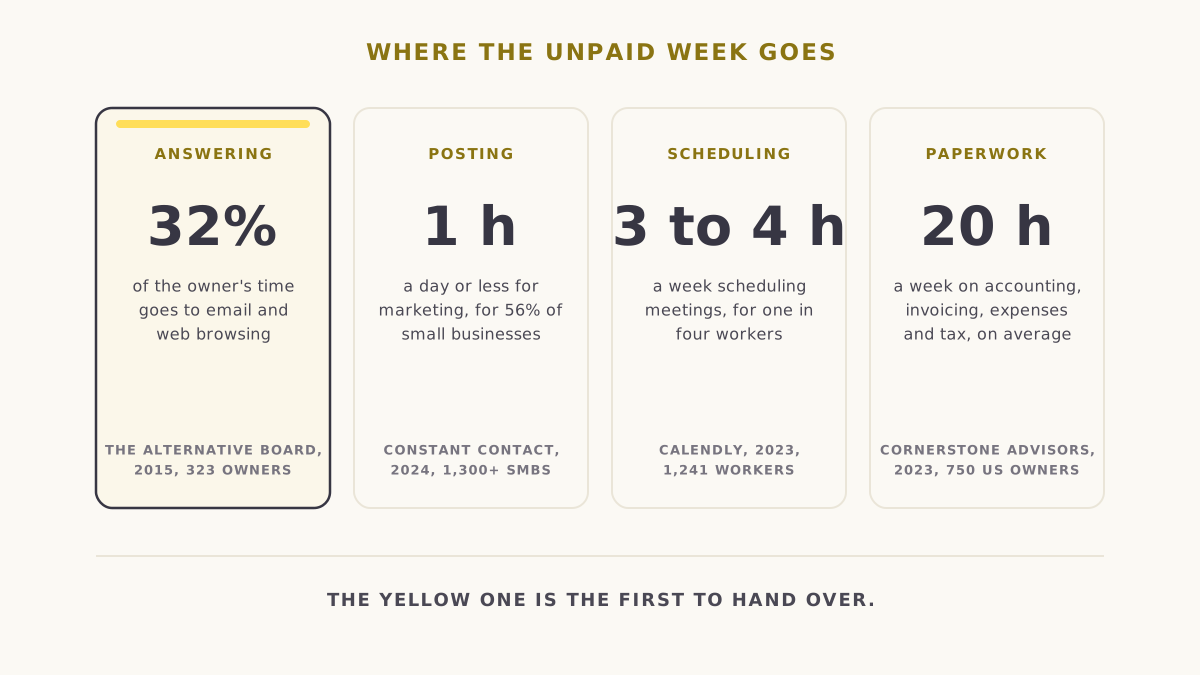
Your week is not long because of the work. It is long because of everything around the work. Owners report weeks of 49 to 60 hours, and six in ten say they work more than fifty. A fifth to a third of that week is administration, accounting alone takes about twenty hours a week in one US survey of 750 owners, marketing gets an hour a day or less for roughly half of small businesses, and a quarter of office workers spend three to four hours a week just scheduling meetings. The government's own time-use survey adds the honest detail the vendors leave out: the self-employed do not work longer days than employees, they work more weekends. The hours fall into four buckets, answering, posting, scheduling and paperwork, and the first one is the one to hand over, because it is the only one with no judgment in it.
When I sit down with an owner, the first thing I ask for is not the revenue. It is the week. Draw it for me, Monday to Sunday, and mark the hours a customer would pay for.
Most people start confidently and slow down around Wednesday. The paid hours are there, usually fewer than they thought. The rest is a long list of small things with no line on an invoice: the messages answered from the truck, the post that took an hour because nothing came to mind, the four calls to land one estimate, the quote written at eleven at night, the reminder about the invoice from March. The method is the one I learned at Tupy, where my job was to interview people across departments and work out what the data already answered before building anything. The data almost always answers this: the business is the forty hours, and the other twenty are the business happening to you.
I went looking for how well that pattern is measured. The answer is: unevenly, mostly by companies selling a cure, and with one government source that disagrees with them in an interesting way. Here is all of it.
How long the week really is
The Alternative Board surveyed 323 owners in December 2015 and found that they average 49.4 hours of work a week but think they should be working 41.7; 63% worked more than fifty. Gallup, with a proper probability sample of 607 US owners, found in 2005 that owners put in 52 hours a week on average, 62% worked fifty or more, and 57% worked six or more days. That is twenty years old and still the cleanest sample anyone has drawn. The newest number is the steepest: UENI surveyed 837 US businesses with five or fewer employees in May 2024 and found a median of 60 hours a week, with 62% of owners over fifty.
Now the source nobody quotes, because it does not flatter the argument. The Bureau of Labor Statistics' American Time Use Survey for 2024 shows that unincorporated self-employed workers put in 6.38 hours on the days they work, against 7.59 for wage and salary workers. Shorter days. The difference is elsewhere in the same table: 38.5% of the self-employed worked on a given weekend day, against 27.9% of employees. An earlier release found the self-employed nearly three times as likely to have worked from home on a workday, 58% against 20%. The owner's week is not made of longer days. It is made of more of them, in more places, which is exactly what the kitchen table at eleven at night looks like from the outside.
Where the hours go

When I add up what owners tell me, the unpaid hours fall into four buckets. The sources, such as they are, line up with them.
1. Answering
The owners in the Alternative Board survey spent 32% of their time on email and web browsing, more than they spent with employees (25%) or with customers (21%), and when asked what frustrated them most, a third said unscheduled communications. Asked where they waste the most time, they said emails and administrative tasks. Meanwhile the messages that matter wait: in Jobber's December 2025 survey of 1,050 US home-service owners, 20% said they reply to a new lead within the hour, while the same owners believe more than half of their customers expect exactly that. I wrote about what that gap costs in the article before this one. Here the point is simpler: answering is the bucket that fills itself, all day, in pieces too small to see.
2. Keeping the feed alive
The most-quoted figure here is also the most misquoted. In 2012 VerticalResponse surveyed 462 of its small-business customers and 43% said they spent six or more hours a week on social media. The number people repeat is "about six hours", which is not what it says. And the same infographic has a row for owners specifically: 63% of them spent one to five hours a week, 23% six to ten, and a third wanted to spend less. What took the most time was not posting. It was finding something to post.
More recent and more sober: Constant Contact's survey of over 1,300 small-business decision makers in February 2024 found that 56% have an hour or less a day for marketing of any kind, and that the single most time-consuming marketing task was posting on social media, named by 51%. The 2025 edition, with 2,500 respondents across four countries, found that just 18% feel confident in their results, down from 27% the year before. An hour a day, every day, spent on the task the owner trusts least.
3. Finding a slot
For an office worker the slot is a meeting. For you it is an estimate, and an estimate you cannot schedule is a quote you never give. The only measured data is from offices. Calendly's survey of 1,241 US and UK workers in 2023 found that one in four spend three to four hours a week scheduling meetings, half a working day; its 2024 edition of 1,244 workers put 43% at three hours or more. Both surveys were paid for by a company that sells scheduling, so take the direction and not the decimals. From the owner's side of the counter, the figure that matters is the one from the previous article: 80% of US homeowners say online booking influences who they hire, and 14% of pros value offering it.
4. The paperwork: quotes, invoices, the chase
The quote first. Companies that answer formal bids told Loopio in 2025 that a response takes 25 hours of writing on average, and 20 hours at small companies; that is 1,544 proposal professionals describing procurement documents, not your kitchen-table estimate, but it is the honest upper bound of what a proposal costs without a system. The lower bound is on the other side of the same industry: Proposify's users, working from templates and a price list, create a proposal in 17 minutes on average. The owner who writes every quote from a blank page lives somewhere between those two numbers, and closer to the first than they think.
Then the money. Cornerstone Advisors surveyed 750 US small-business owners and executives in late 2023 and found they spend about 20 hours each week on accounting functions, split between bookkeeping, invoicing, expenses, reporting and tax. Sage's 2017 study of more than 3,000 small and medium businesses in eleven countries put administration at around 5% of working time, about 120 person-days and 50,000 dollars a year per company, and singled out the US, at 4.9% of time, as a country where the average small company effectively needs one full-time person for administration. Those person-days are spread across staff in a company that has staff. In a company of one, every one of them is yours.
And the chase. QuickBooks surveyed 2,487 US small businesses in January 2025: 56% were owed money on unpaid invoices, 17,500 dollars on average, and 47% had invoices more than thirty days overdue. A year later, 59% had invoices overdue by thirty days or more. Neither edition counts the hours spent chasing. The UK government did, in a 2025 study of 1,455 businesses: 86 hours of staff time a year per business affected by late payment. That is British data, and I have no reason to believe an American invoice is chased faster.
This is not a small-business disease
If this were about being small, a company with five thousand employees would be immune. Microsoft measured its own customers and found the opposite. Across its apps in 2023, the average employee spent 57% of their time communicating and 43% creating; the heaviest email users spent 8.8 hours a week on email; 68% said they did not have enough uninterrupted time, and 62% said they spent too much time searching for information. By 2025 the same telemetry showed employees interrupted every two minutes during core hours, 275 times a day, with 60% of meetings unscheduled. That is 31,000 knowledge workers in 31 countries, and it is your week with a bigger payroll.
The people paid only to sell fare no better. In Salesforce's 2022 survey of 7,775 sales professionals, reps spent 28% of their week actually selling; HubSpot's 2023 survey of over 1,400 put it at two hours a day. The large company has the owner's problem, spread across a floor of people who each own a slice of it. The owner has the whole thing, after hours.
The numbers I refused to use
You will have seen some of these. "It takes eight emails to schedule a meeting." "Knowledge workers spend 28% of the week on email," credited to McKinsey. "A 2025 SCORE survey found owners spend 23 hours a week on admin." "Owners spend 68.1% of their time working in the business and 31.9% on it."
The eight emails trace to nobody; it is folklore with a number attached. The McKinsey report exists, but I could not open it while writing this, and a figure I have not read does not go in your hands. The SCORE survey appears only on aggregator sites and nowhere on SCORE's own, which is usually how a made-up study looks. And the 68.1% is a decorated version of the Alternative Board's actual sentence, which says owners spend 32% of their time working on the business, with no decimals. The real sentence was enough.
What I would do this week
Draw the week before you change it. Five working days, half-hour blocks, written down as you go. Mark every block a customer would pay for. Owners who do this honestly find fewer paid hours and more pieces than they expected, and the pieces are the point.
Sort the rest into the four buckets. Answering, posting, scheduling, paperwork. Put a number of hours next to each. Those four numbers are the real cost of running the business, and they are what the next decisions are about.
Hand over in order of judgment, not of pain. Answering first, because the first reply has no judgment in it and can be fixed on paper this week. Scheduling second, which means a calendar someone other than you can see. Paperwork third, which starts with a quote template and a price list. Posting last, and only once there is a written plan for what the posts are for.
Put the records in one place before you automate any of it. An agent that cannot find the price list writes the quote from memory, like you do. I wrote about where a business keeps the truth, and that article is the precondition for this one.
Give the evening back to the bench. The point is not to work less. It is that the hours you keep should be the ones the customer pays for, and the ones nobody pays for should stop depending on you being awake.
What this has to do with Holybiz
The first bucket is where we start with every owner, and it is deliberately the boring one: an agent that answers in minutes, asks the same questions, drafts the quote from your price list and waits for your yes, then follows up on day two and day five. Booking from your calendar and the reminder the day before are being built. The paperwork and the posting come after, and only once the records live somewhere an agent can read. I would rather hand you one bucket that works than four that sound good.
What changes in the first month is not the revenue. It is the drawing of the week, which starts to look like a business instead of a diary.
Owners report weeks of 49 to 60 hours and six in ten work more than fifty (Alternative Board 2015, Gallup 2005, UENI 2024). The government's time-use survey shows shorter days than employees and far more weekends.
The unpaid hours fall into four buckets: answering, posting, scheduling and paperwork. Owners name email and admin as their biggest waste, and spend 32% of their time on it.
Marketing gets an hour a day or less for 56% of small businesses, posting is the most time-consuming task, and only 18% feel confident in the results.
Accounting alone takes about twenty hours a week in a survey of 750 US owners; administration is around 5% of working time, 120 person-days and 50,000 dollars a year per company across eleven countries.
Large companies have the same week with a bigger payroll: 57% of time communicating, interruptions every two minutes, sales reps selling 28% of the time.
The eight emails, the McKinsey 28%, the SCORE survey and the 68.1% are not here, because none of them could be traced to a page I could read.
Draw the week, sort it into the four buckets, hand them over in order of judgment, and put the records in one place first.
Read next

Customers pay more to the company that looks like it knows what it is doing
A fast first reply, a visit with a checklist, a complete proposal, a short presentation and two follow-ups are not good manners. They are how a customer who cannot judge your work decides what it is worth, and the margin follows that judgment. The research on how people read price, design and trust, and what winning proposals actually contain.
Patricia de Castro Araujo·Oct 3, 2026
The customer called while you were on the roof. Nobody answered.
Every service owner I interview tells me the same three stories: the reply that came too late, the quote that went out too late, the day lost confirming what was already agreed. Here is what the sources actually say those three hours cost, which famous numbers I refused to use, and why a company with seventy salespeople bleeds in exactly the same place.
Patricia de Castro Araujo·Sep 19, 2026
Agents don't hallucinate on their own, they get overloaded
Agents rarely hallucinate because the model is broken. They hallucinate because one chat was asked to be memory, filing cabinet and five specialists at once.
 Janderson Araujo·Sep 5, 2026