
The most expensive mistake small businesses make with digital presence


In this article
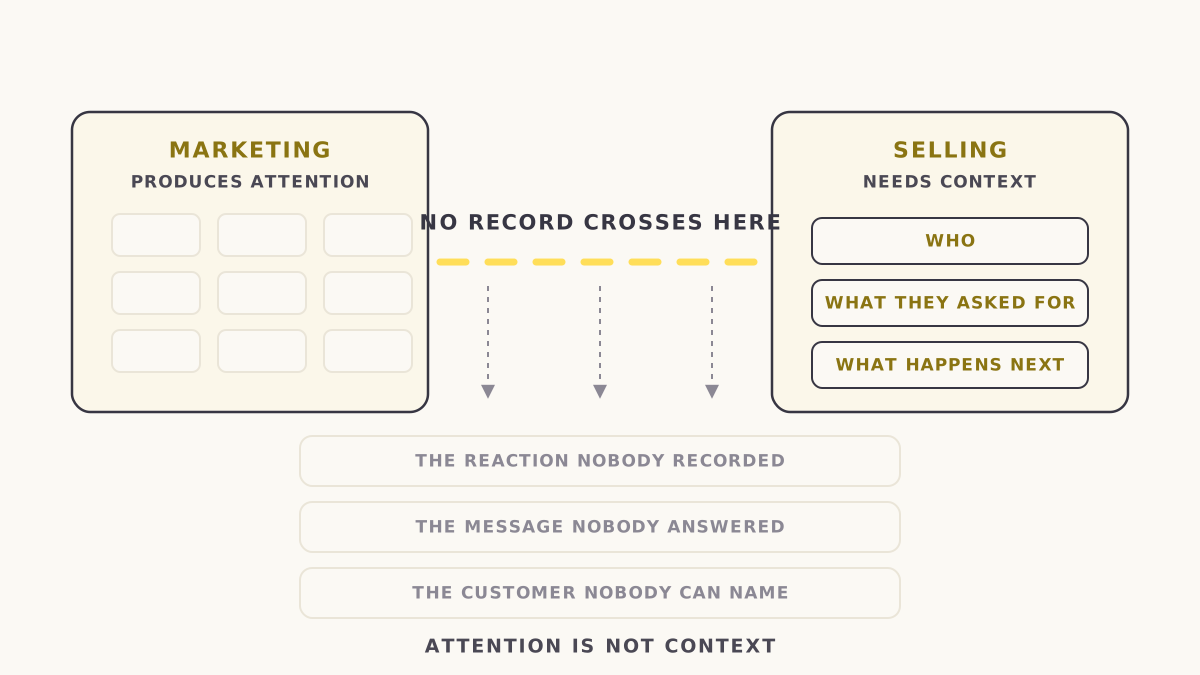
The expensive mistake is not being invisible. It is having a presence that never connects to the part of your business that takes money. Marketing produces attention, selling needs context, and in most small companies nothing carries one into the other: the post goes out, someone reacts, and the record of who they were and what they wanted stops at the platform. That handoff is a seam, and a seam with no record is where leads die quietly. What changed in 2026 is that producing content became free, so both sides of the seam now move faster while the gap between them stays exactly as wide. Fix the seam before you produce more.
Almost every owner I meet has already been told the wrong version of this. The wrong version says the mistake is not being online enough: not posting enough, not being on the newest platform, not having a website.
I have run this interview through hundreds of small and medium companies since 2019, and being absent is rarely what costs them. Plenty of businesses with almost no presence make a good living, because they are wired: someone calls, the right person hears about it, the work gets done, the customer comes back. The expensive mistake is the opposite shape. A business with real presence, real attention, real reach, and no wire from any of it to the part of the company that takes money.
Why I can see this particular seam
I did not learn this in marketing. I learned it building the plumbing.
Before I founded anything, I spent eleven years in enterprise technology, eight of them inside Tupy, Latin America's largest foundry and the world's largest maker of cast iron engine blocks and cylinder heads. I was a business analyst in logistics and sales, and I built systems across the commercial area, marketing, clients, orders, invoicing, sales administration, contracts, distribution and export, down to the shipment taxation books.
That means I spent eight years building, by hand, the exact connection I am telling you about. I know where it breaks, because I was the person who had to make it not break, in a company where a broken handoff meant a container did not ship.
Then at Sizebay, the company I co-founded, I owned the sales process from 2014 and executed it myself before supporting two other salespeople. Same seam, a thousand times smaller, and it broke in the same place.
The seam, named plainly
Marketing's output is attention. Selling's input is context.
Attention is a person who is briefly interested. Context is knowing who they are, what they asked for, what they were told, and what happens next. Those are not the same object, and turning one into the other requires somebody to write something down.
In a big company, that is a system with a budget. In a small one, it is usually nothing at all. The post performs, the comments come in, a few people message, and the entire record of that interest lives inside a platform that belongs to somebody else and that you will never query.
The result is a business that can prove it is being noticed and cannot say who noticed.
What actually changed, and why it got worse
Here is the part I could not have written two years ago.
Producing content used to be the bottleneck. It was slow and it cost real money, so a small business made a handful of things a month and the trickle of attention was small enough that a human could catch it informally. The seam leaked, but it leaked at a rate a person could absorb.
That bottleneck is gone. Anyone can now produce a month of competent posts in an afternoon, in three languages, with images. So the volume on the marketing side went up by an order of magnitude, and the sales side did not change at all.
A leak scales with what flows through it. Widening the pipe upstream of a gap does not fill the gap, it just increases what falls through. This is why I now meet businesses whose presence looks better than it ever has, and whose sales conversations are exactly as thin as before, and who conclude from that combination that marketing does not work.
Marketing worked. It handed you attention and there was nothing there to catch it.
Three questions that expose it in ten minutes
Ask these about your own business. They are uncomfortable in a useful way.
Name the last five people who came to you from anything you published. Not how many. Their names. If you cannot, the seam is open, and everything else on this list is confirmation.
For the last thing you posted, what was the next step you wanted the reader to take, and where does that step get recorded? A lot of posts have no next step at all. Some have one that leads to a channel nobody watches.
When someone reacts to a post and then buys three weeks later, how do you know those were the same event? If the answer is that you happen to remember, you have a memory, not a system, and it does not survive you being busy.
The smallest version that works
You do not need a marketing stack. You need one wire.
One place where an inbound contact becomes a record, whatever tool that is, including a spreadsheet as a first step. What matters is that it exists and that it wins when two places disagree.
One next step per thing you publish, and it points at a channel you actually watch.
One person, by name, who owns moving a record forward.
One habit: every conversation that starts on a platform gets its facts copied into the record within the day. Platforms are where attention happens, never where truth lives, because you do not own them and you cannot query them.
That is the whole build. Everything more sophisticated than this is an optimization of a wire that has to exist first.
The honest limit
An agent helps here, and I want to be precise about how, because this is where people expect too much.
An agent can watch your channels and write every inbound contact into the record, ask the same qualifying questions, and never forget to do it at eleven at night. That is real, and it is usually the first agent we build with an owner.
What an agent cannot do is decide what your next step should be, or care whether the attention you are buying is the right attention. It will faithfully record a hundred contacts who were never going to buy anything. Closing the seam makes your business legible. Whether what becomes legible is any good is still your judgment, and it always will be.
What this has to do with Holybiz
Janderson and I run Holybiz this way, which is the only reason we are comfortable telling you to. We publish, and every contact lands in one place with a name on it, and neither of us has to remember anything for that to be true.
When we sit with an owner, this is the second conversation, right after the one about what they actually sell. Not because plumbing is exciting. Because attention you cannot account for is the most expensive thing a small business buys.
Being absent is rarely the expensive mistake. Presence with no wire to the part of the business that takes money is.
Marketing's output is attention. Selling's input is context. Turning one into the other requires a written record, and that record is what small businesses do not have.
Producing content became free, so the marketing side scaled by an order of magnitude while the seam stayed exactly as wide. A leak scales with what flows through it.
The ten-minute test: name the last five people who came to you from something you published. Names, not counts.
Platforms are where attention happens, never where truth lives. You do not own them and you cannot query them.
An agent can close the seam by recording everything faithfully. It cannot tell you whether the attention was worth having.
Read next

Customers pay more to the company that looks like it knows what it is doing
A fast first reply, a visit with a checklist, a complete proposal, a short presentation and two follow-ups are not good manners. They are how a customer who cannot judge your work decides what it is worth, and the margin follows that judgment. The research on how people read price, design and trust, and what winning proposals actually contain.
Patricia de Castro Araujo·Oct 3, 2026
Your week has forty hours of work in it and sixty hours of business
Answering the phone, keeping the feed alive, finding a slot for an estimate, writing the quote, chasing the invoice. None of it is the job the customer pays for, and it is where most of a small-business owner's week goes. What the surveys actually measured, where the government data disagrees with the vendors, and which bucket to hand over first.
Patricia de Castro Araujo·Sep 26, 2026
The customer called while you were on the roof. Nobody answered.
Every service owner I interview tells me the same three stories: the reply that came too late, the quote that went out too late, the day lost confirming what was already agreed. Here is what the sources actually say those three hours cost, which famous numbers I refused to use, and why a company with seventy salespeople bleeds in exactly the same place.
Patricia de Castro Araujo·Sep 19, 2026