
How do you pick the first process to hand to an agent?


In this article
Pick the process that is repetitive, already written down somewhere, and cheap to get wrong. Not the one that hurts most. Painful processes are usually painful because they carry judgment, and judgment is the last thing a business should hand to an agent. Four filters decide it, in order: how often the work happens, whether it already exists on paper, how cheap a mistake is to fix, and whether one named person owns the result. The first agent's job is to prove that the loop of writing, running and reviewing actually works. It is not there to rescue the business.
When I sit down with an owner for the first time, there is almost always a list already waiting for me: the four or five things they most want off their plate. I have learned not to trust the order that list arrives in. It is sorted by pain, and pain is not the same thing as readiness.
I have been sorting lists like this for a long time, well before agents existed. Eight years inside Tupy, Latin America's largest foundry, taught me to read a real operation before I ever gave anyone advice about one: I sat with logistics, with sales, with invoicing and export, and I built the systems the sale actually ran through, from the order to the tax book. Later, when I co-founded Sizebay, I wrote the first validation algorithm myself and made the first sale with my own hands before I ever taught a salesperson to make the next one. SEBRAE, Brazil's national agency for small business, does not hand out its accreditation for showing up. It validates a consultant's actual track record first, and it is demanding. I passed that review, and since 2019 I have used the same method on hundreds of small and medium companies: interview every department, find out what the data already answers, and build only what is actually missing.
An agent is just the newest thing I build with that method. The interview does not change. What changes is that the answer used to be a spreadsheet, or a CRM finally connected the way it should have been from day one. Now it can be an agent.
The instinct I correct most often
In engagement after engagement, the instinct is the same: reach for the process that hurts. The owner who dreads writing estimates. The shop that loses a week every month reconciling invoices. The service business where one person is the only one who can talk a nervous customer down. All of that pain is real. None of it, by itself, tells me the process is ready for an agent.
Painful work is usually painful because somebody in it is making a judgment call, and judgment is the last thing you hand to a beginner, whether that beginner is a new hire or a new agent. Automate the painful process first and you have not removed the judgment. You have just made it harder to see where it went missing.
The four filters I actually use
This is the working method I bring into the room, the same one that used to sort spreadsheet requests and now sorts agent candidates.
Frequency. It has to happen weekly or more. A quarterly task will not give the agent, or the person reviewing it, enough repetitions to build the habit of checking the work.
Written form. Somewhere, a template, a checklist, an old email thread or a spreadsheet already shows how the work gets done today. If the only copy of it lives in someone's head, writing it down is the first week of the engagement, not a step you get to skip.
Cheap failure. A wrong output should cost a correction, not a client, a dollar amount or a signature on a contract. I keep the first agent away from anything that touches money or a customer's inbox unsupervised.
A named owner. One person, by name, is accountable for reviewing the output and saying when it is good enough. No owner, no agent. I have never once seen this filter fail to matter.
I do not judge the first agent by how much time it saved. I judge it by whether the team could run the next one without me in the room.
What week one looks like
Week one never starts with the agent. It starts with the process, written the way it actually runs today, exceptions included: the client who always asks for the discount, the invoice that never matches the purchase order, the job that comes in on a Friday afternoon. I ask whoever owns the process to define, in one sentence, what a correct output looks like: something the reviewing person can check against in under a minute.
Only then does the agent run, and it runs alongside the person who used to do the work by hand, for a few cycles, not one. Every correction goes back into the written process, never into a private prompt that only one person can see. That is the same discipline I have carried since Tupy and since Sizebay: the value is never in what I know, it is in what the team can keep using after I leave the room. By the end of the first week, the team owns two things: a document and a habit of checking it. The document is worth more than the agent.
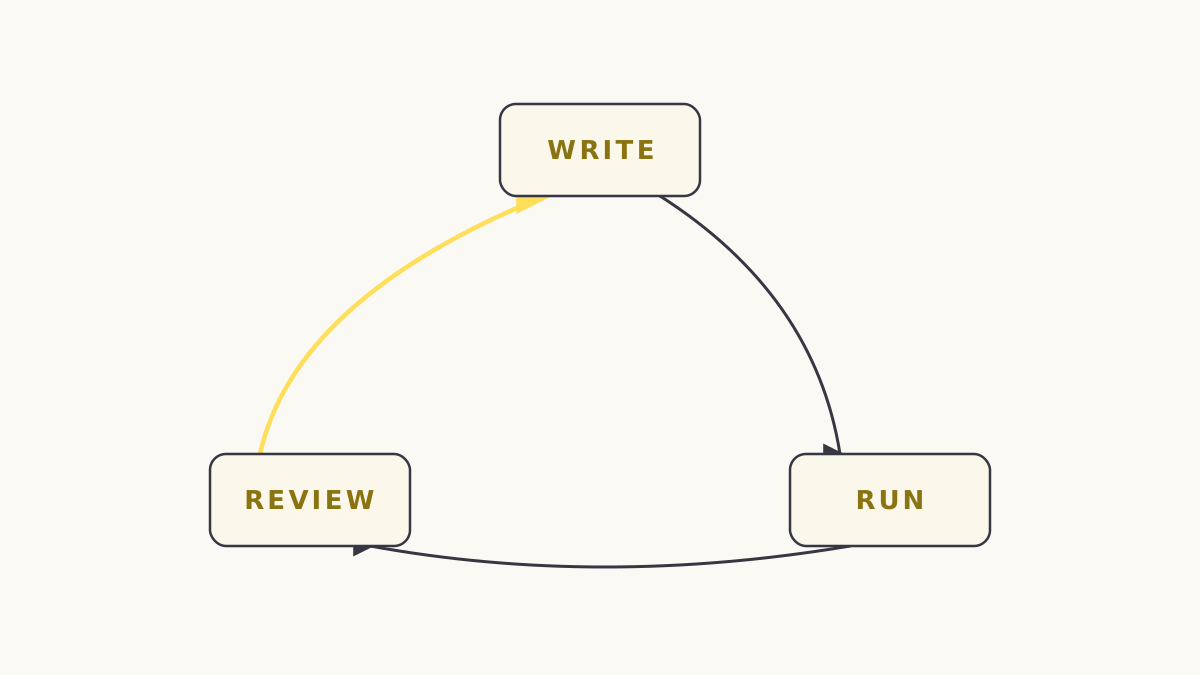
Then you repeat it on the next process, and this time the team runs the loop without me.
What this has to do with Holybiz
This is not a new skill I picked up because agents arrived. It is the same craft I have practiced since Tupy and since Sizebay, aimed at a new kind of hire. At Holybiz, this is where every engagement starts, the way Janderson and I run our own company: map how the work actually happens, find the one piece that is ready to hand off, and leave the owner with a team, agents included, that they can run without us.
Sort your list by readiness, not by pain. The processes that hurt most usually carry judgment, which is the last thing to delegate.
If nobody has written the process down, writing it down is the whole first week, and it pays for itself even if no agent ever gets built.
Every correction belongs in the written process, never in a private prompt only one person can see.
I do not measure the first agent by time saved. I measure it by whether the team can run the next one without me.
This is the same method I have used since Tupy and Sizebay: interview the department, find what the data already answers, build only what is missing. An agent is just the newest thing that method builds.
Read next

Customers pay more to the company that looks like it knows what it is doing
A fast first reply, a visit with a checklist, a complete proposal, a short presentation and two follow-ups are not good manners. They are how a customer who cannot judge your work decides what it is worth, and the margin follows that judgment. The research on how people read price, design and trust, and what winning proposals actually contain.
Patricia de Castro Araujo·Oct 3, 2026
Your week has forty hours of work in it and sixty hours of business
Answering the phone, keeping the feed alive, finding a slot for an estimate, writing the quote, chasing the invoice. None of it is the job the customer pays for, and it is where most of a small-business owner's week goes. What the surveys actually measured, where the government data disagrees with the vendors, and which bucket to hand over first.
Patricia de Castro Araujo·Sep 26, 2026
The customer called while you were on the roof. Nobody answered.
Every service owner I interview tells me the same three stories: the reply that came too late, the quote that went out too late, the day lost confirming what was already agreed. Here is what the sources actually say those three hours cost, which famous numbers I refused to use, and why a company with seventy salespeople bleeds in exactly the same place.
Patricia de Castro Araujo·Sep 19, 2026