
Why your small business is losing leads (and how to fix it today)


In this article
You are probably not short of leads. You are losing the ones you already get, in the gap between someone raising their hand and someone answering them. That gap is the cheapest thing in your business to fix and the one part of selling that carries no judgment at all, which is exactly why it is the first thing worth handing to an agent. A good first reply does four things: it names a real human, it names a time, it asks the same qualifying questions every time, and it writes the answers somewhere a person can find them. It must never quote a price, promise a date nobody approved, or pretend to be a person. Everything after that first reply still belongs to you.
Most owners who tell me they need more leads do not need more leads.
I ask them to do something uncomfortable instead: open every channel where a stranger can reach the business, and count. The website form, Instagram messages, WhatsApp, the phone, the email nobody watches. Then count how many of those got an answer the same day, and how many never got one at all.
That number is almost always worse than the owner expected, and it is almost always the real problem. You are not invisible. You are unanswered.
The three ways it actually happens
I wrote about this two years ago and the diagnosis has not aged. What I see, in this order of frequency:
There is no follow-up process. Someone asks, someone answers, and then the thread just stops. Nobody decided whose job the second message was, so it never gets sent.
The reply is too slow. Not slow by your standards. Slow by the standards of whoever else they messaged that afternoon.
The information is scattered. The context of the conversation lives in a phone, the price lives in a spreadsheet, the availability lives in someone's head. So even a willing person cannot answer quickly, because answering means assembling.
The third one is why I gave records their own article. This one is about the first two, and specifically about the sentence that closes the gap.
The number I am not going to quote
There is a statistic everyone reaches for here. You have seen it: something like seventy-eight percent of customers buy from the company that responds first, usually credited to a large software vendor.
I am not going to use it, because when I went looking for the primary source it is not from that vendor at all, and the trail runs into a chain of blog posts citing each other. It may well be roughly true. I do not know that it is, and I am not willing to put a number in your hands that I cannot show you the origin of.
Here is what I can show you instead. At Tupy, Latin America's largest foundry, I spent eight years building the systems the sale actually ran through, from the order to the invoicing and the export documents. From 2014 at Sizebay, the company I co-founded, the sales model was mine to prove: I made the sales myself and then supported two other salespeople doing it. Since 2019, accredited by SEBRAE, I have run the same interview through hundreds of small and medium Brazilian companies.
In all of that, I have never once found a business that answered fast, followed up reliably, and still had a lead problem. That is not a statistic. It is the pattern I actually have standing to describe.
Why the first reply is the piece to hand over
If you have read what I wrote about which part of your funnel is ready for an agent, you know the top passes every readiness filter I use. This is the next layer down: not whether an agent takes the first touch, but what that first touch has to say.
The first reply is unusual, and it is worth naming why. Almost every other part of selling is judgment: reading whether someone is nervous about price, deciding when to push and when to wait, knowing which exception to make. The first reply has none of that in it. It is pure speed and consistency. Its entire job is to convert a stranger's uncertainty into a known next step.
A person is bad at that specific job, through no fault of their own. People sleep, take lunch, drive, and get absorbed in the work they are already being paid for. An agent is good at exactly that job and bad at all the others. This is one of the few places where the tool and the task line up cleanly.
What a good first reply contains
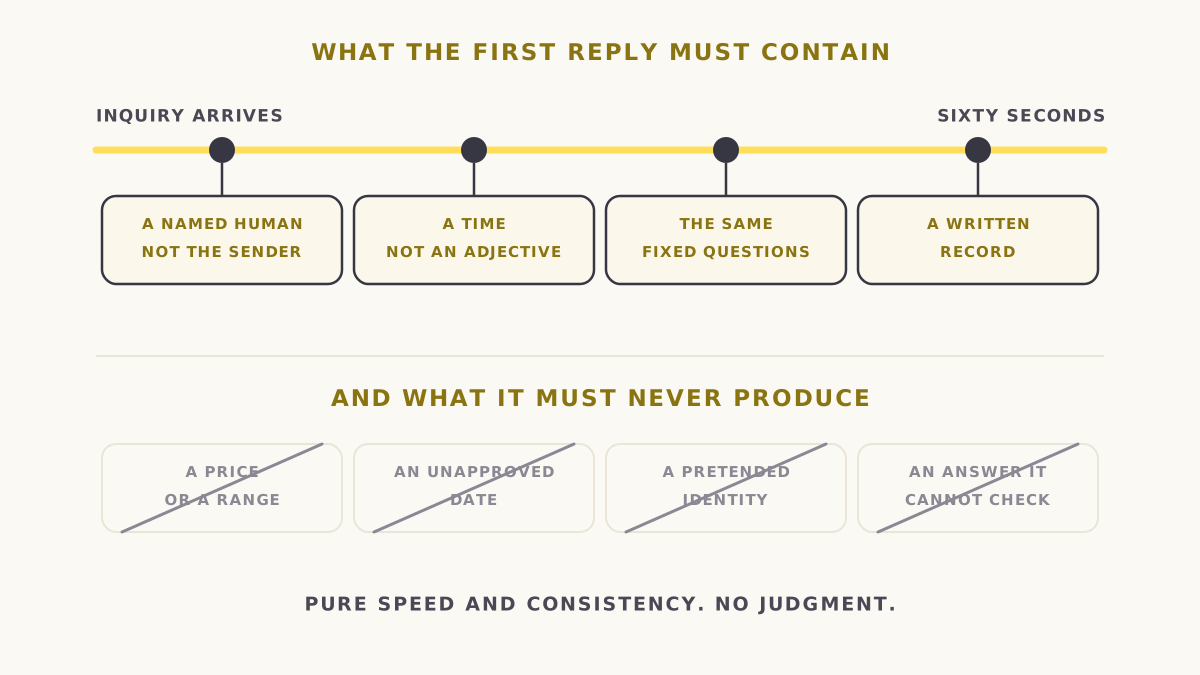
Four things, and none of them are clever.
A real human's name, and that it is not the one writing. "Patricia will follow up with you." The visitor should never be in doubt about who they are talking to. If an agent wrote the message, the message says so.
A time, not an adjective. "Before end of day tomorrow" beats "shortly" every time, because the second one is a promise you cannot break, which means it is not a promise.
The same three or four qualifying questions, every time. What are you trying to get done, by when, and have you done this before. Same questions, same order, so the answers are comparable across a hundred conversations.
A record. The answers go into the one place your business treats as true. If they land only in the chat, the reply was polite and useless.
What it must never do
This list matters more than the one above, because these are the failures that cost you something you cannot take back.
Never quote a price. Not an estimate, not a range, not "usually around". Pricing carries judgment and exceptions, and a number said out loud is a number you now have to honour.
Never promise a date nobody approved. The agent does not know your Tuesday.
Never pretend to be a person. Not for ethics alone, though that is reason enough. Because the moment a customer works it out, and they do, every other thing you told them comes into question.
Never answer a question it cannot check. "I don't know, and Patricia will tell you tomorrow" is a good answer. A confident wrong answer is not.
What I would do this week
None of this needs software you do not have.
Count. Every channel, last thirty days. How many inquiries, how many answered same day, how many never answered. Do this before deciding anything.
Write the reply. One paragraph, on paper, containing the four things above. This is the whole specification for an agent later, and it improves your business immediately even if you never build one.
Write the questions. Three or four, fixed order.
Pick the name. One person, by name, who owns the second message. No name, no process.
Then, and only then, automate the sending. The agent is the last step, not the first. It is there to hold a standard you already wrote down, at hours you cannot cover.
What this has to do with Holybiz
This is usually the first agent we build with an owner, and it is deliberately unambitious. It does not sell. It does not negotiate. It answers within minutes, asks the same questions, and writes down what came back, so that when a human picks up the conversation they are starting from something instead of from nothing.
What it changes in the first month is rarely the sales number. It is that the owner finally knows how many people are asking, and what they are asking for. Everything after that decision gets cheaper, including the decision to hire.
Count before you conclude. Most businesses that believe they need more leads are losing the ones they already have, unanswered.
The first reply is the only part of selling with no judgment in it, which is exactly why it is the safest thing to hand to an agent.
A good first reply names a real human, names a time, asks the same fixed questions, and writes the answers where the business keeps the truth.
It must never quote a price, promise an unapproved date, pretend to be a person, or answer confidently something it cannot check.
Write the reply on paper first. It improves the business immediately, and it is the entire specification for the agent later.
I will not quote you the response-time statistic everyone quotes. I could not trace it to a primary source, and a number I cannot show you the origin of is not evidence.
Read next

Customers pay more to the company that looks like it knows what it is doing
A fast first reply, a visit with a checklist, a complete proposal, a short presentation and two follow-ups are not good manners. They are how a customer who cannot judge your work decides what it is worth, and the margin follows that judgment. The research on how people read price, design and trust, and what winning proposals actually contain.
Patricia de Castro Araujo·Oct 3, 2026
Your week has forty hours of work in it and sixty hours of business
Answering the phone, keeping the feed alive, finding a slot for an estimate, writing the quote, chasing the invoice. None of it is the job the customer pays for, and it is where most of a small-business owner's week goes. What the surveys actually measured, where the government data disagrees with the vendors, and which bucket to hand over first.
Patricia de Castro Araujo·Sep 26, 2026
The customer called while you were on the roof. Nobody answered.
Every service owner I interview tells me the same three stories: the reply that came too late, the quote that went out too late, the day lost confirming what was already agreed. Here is what the sources actually say those three hours cost, which famous numbers I refused to use, and why a company with seventy salespeople bleeds in exactly the same place.
Patricia de Castro Araujo·Sep 19, 2026