
“[Opinion] What makes companies invest in e-commerce stores?”
Original headline: “Opinião: O que faz as empresas investirem em lojas virtuais?”

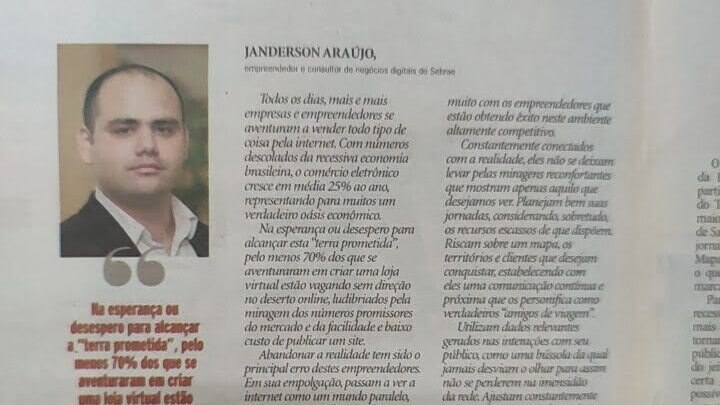
This one is written by Janderson, not about him. An opinion column in one of the state's most traditional newspapers, founded in 1923, arguing why companies were moving into online stores and what they were underestimating about it.
What the column argues
The oldest piece in this record, and the only one in his own voice. The paper asked him, in 2015, for a business-section column on why stores and entrepreneurs were moving online. He used it to tell them most of them were doing it badly.
It opens on the arithmetic of that year: the Brazilian economy contracting, online retail growing by an average of 25% a year, an oasis for anyone with something to sell. Then it turns on the rush. At least 70% of the people setting out to build an online store, he wrote, were wandering with no direction, taken in by encouraging market statistics and by how cheap and easy publishing a site had become.
In the hope, or the desperation, of reaching the promised land, at least 70% of those who set out to create an e-commerce are wandering online with no direction.
His diagnosis is not technical. Enthusiasm, he argues, makes founders treat the internet as a parallel world where the basic rules of economics and administration are suspended, a place of fairies and animated gifs where publishing a store is the same thing as being found by millions of people who will then click and buy. Giving up on reality is the phrase he uses, and he calls it the main mistake.
The advice is the part that has not aged. Plan the journey around the resources you actually have. Decide which territory and which customers you intend to convince, and keep the conversation with them going. Use the data your own interaction with them produces as a compass. Keep adjusting the business so that it still makes sense to those customers. And above all, build a value proposition that is unique, clear and relevant, or a price comparison engine will file you next to everything else that looks the same.
Eleven years later the tools have changed and the failure has not. The stack is agents now instead of a shopping cart, and the mistake is still buying the tool before deciding who the business is for.
It ran in print, so there is no link. The photograph above is the page as it circulated, his byline under the title of digital business consultant for Sebrae. The column was written in Portuguese; the English here is ours.


“AI promises consumers a smart wardrobe”
Valor Economico on how AI is reaching the wardrobe, with Janderson among the voices it interviewed. He is quoted on the shift from recommending a size to helping someone get dressed, and on what a company owes a person whose photograph it processes.

“Sizebay: virtual fitting room grows more than 40% in Europe with technology made in Brazil”
The company reports 41% revenue growth in Europe and 35% in Brazil over the year, 65 countries and 1,200 virtual stores, with the new AI personalization platform at roughly 20% of quarterly new recurring revenue. Janderson is quoted as co-founder. The figures are the company’s claims as reported.


“Sizebay launches AI solutions for fashion stores at Fórum ECBR 2025”
The AI-era product work becomes public: Fashion Hub, which pairs generative AI with consumer behavior data for hyperpersonalization, and Size & Fit, both presented at Fórum E-Commerce Brasil 2025. This is the product chapter Janderson led during the earnout, told by the trade press.