
Which part of your sales funnel is ready for an agent?


In this article
The top. Capturing a lead, answering it in minutes, asking the same qualifying questions every time and writing down what came back is repetitive, already scripted, and cheap to get wrong, so it passes every filter I use. The middle passes too, as long as a person reviews what gets sent. The bottom fails three filters out of four: negotiation, price exceptions and the objection that is really a fear happen rarely, live nobody's head but the seller's, and cost you the deal when they go wrong. So put the agent where the volume is and the stakes are low, keep the human where the judgment is, and be honest that a funnel nobody records cannot be automated at all, only accelerated into a bigger mess.
How many new contacts does your business make in a day?
Most owners cannot answer that, and I mean that without judgment, because I have asked it hundreds of times. The answer usually arrives as a range, or as a story about last month, or as a confident number that turns out to be the number of messages received rather than the number of people actually spoken to.
Six years ago I wrote that a sales funnel is a flight plan: whoever plots the route and tracks it has a much better chance of arriving than whoever leaves themselves at the mercy of the weather. I closed that post by asking whether you could really run all of it by hand, on a spreadsheet or on the back of an envelope. In 2020 the honest answer was "not for long, get a CRM."
The question is the same today. The answer changed, and it changed in a way that is easy to get wrong in an expensive direction.
A funnel is a process, and processes have a readiness
I have written elsewhere about the four filters I use to choose the first process a business hands to an agent: how often the work happens, whether it already exists in written form, how cheap a mistake is to fix, and whether one named person owns the result.
A sales funnel is not one process. It is three, stacked, with very different answers to those four questions. That is the whole insight of this piece, and once you see it the decision stops being a matter of taste.
So let us run the filters, stage by stage, out loud.
Top of funnel: passes all four
The work at the top is capturing a contact, replying fast, asking the same handful of qualifying questions, and recording what came back.
Frequency: daily, often hourly. As high as it gets.
Written form: you already have the questions. They are in your head in a fixed order, and if I sat with you for twenty minutes we would have them on paper.
Cheap failure: a clumsy qualifying question costs you a mild correction. It does not cost a contract.
Named owner: whoever owns new business today.
Four for four. This is where a first agent belongs, and it is also where the pain is quietest, which is exactly why owners skip it. Nobody lies awake over qualifying questions. Meanwhile the lead that came in on Friday at six goes unanswered until Monday, and that is the single most expensive habit I find in small businesses, year after year.
Middle of funnel: passes, with a reviewer
The middle is follow-up, nurture, scheduling, and keeping the record honest as things move.
Frequency is high, the work is scriptable, and the owner is usually clear. The filter that gets tighter is the third one. A follow-up sent at the wrong moment costs you a correction. A follow-up that invents a delivery date, or repeats a discount nobody approved, costs you something you cannot take back. So the middle is agent work with a person reading what goes out, at least until the loop has proven itself over several cycles rather than one good week.
Bottom of funnel: fails three of four
The bottom is the negotiation, the exception on price, the objection that is not really about price, and the moment someone decides to trust you.
Frequency: low. Each one is a handful of times a month, and each one is different.
Written form: almost never. This lives in the seller's judgment, and the good ones cannot fully explain it even when asked.
Cheap failure: no. A wrong answer here costs the deal, and sometimes the referral that would have come after it.
Named owner: yes, usually the owner of the business.
One out of four. I am not saying an agent cannot produce a competent negotiation email. It can, and that is precisely the trap: it will read well, and you will not find out it was wrong until the customer does.
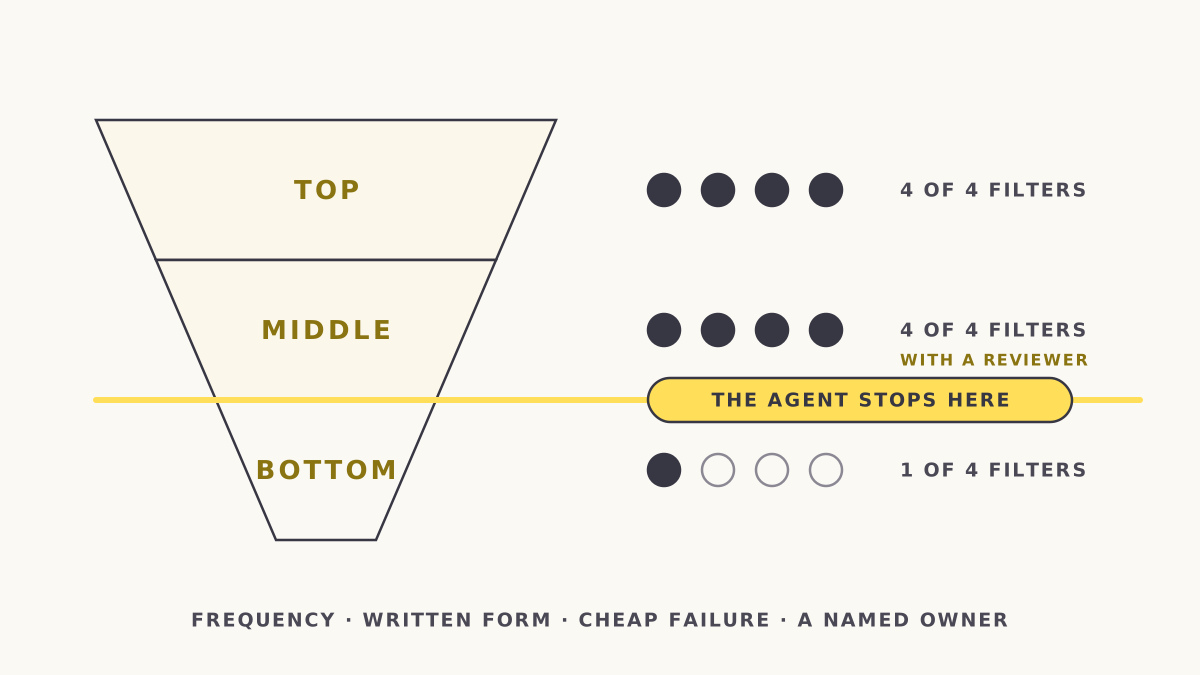
Put the agent where the volume is and the stakes are low. Keep the person where the judgment is. Almost every funnel mistake I see is that sentence reversed.
What this looks like in a real week
A small service business, the shape I have sat with dozens of times. Contacts arrive from a form, from Instagram, from WhatsApp and from the phone. Nobody knows how many. Roughly a third get answered the same day, and the ones that arrive after hours are a coin flip.
The first agent does not sell anything. It watches the channels, replies within minutes to say a real human name will follow up and by when, asks the three or four qualifying questions, and writes the answers into one record. That is it.
What changes in the first month is rarely what the owner expected. It is not usually more sales, at least not yet. It is that for the first time there is a real number for how many new contacts arrive in a day, and a real number for how many were qualified out. That number is the thing you cannot buy, and it is what makes every later decision cheaper, including the decision of whether to hire.
Then, and only then, the middle: the follow-up nobody had time to send, with someone reading it before it goes.
The bottom stays yours. Not forever as a matter of principle, but until you have a written record of how those conversations actually go, which you do not have today.
The prerequisite nobody wants to hear
None of the above works if there is nowhere to write things down. I have made this argument on its own, because it deserves its own room: an agent does not remember, it looks things up, and a business whose real status lives in a WhatsApp thread gives it nothing to look up.
So if you read this and the honest situation is that there is no single place a contact gets recorded, the first project is not an agent. It is one page that says what a contact record must contain and who is responsible for it being true. That page takes an afternoon and it pays for itself even if you never build an agent at all.
Automating a funnel with no record does not organize your sales. It just produces the same confusion at a higher rate.
What this has to do with Holybiz
I did not learn this from agents. I learned it selling.
At Sizebay, the sales model was mine to prove: I made the first sales myself, with my own hands, before I taught two salespeople to make the next ones, and the only reason I could teach them anything was that I had written down what actually happened in those conversations. Before that, eight years inside Tupy, Latin America's largest foundry, building the systems the sale genuinely ran through, from the order to the tax book. And since 2019, accredited by SEBRAE, running the same interview through hundreds of small and medium companies.
The method has never changed: interview the operation, find out what the data already answers, build only what is genuinely missing. What is different now is that the thing you build at the end of it can be an agent instead of a spreadsheet. The judgment about where to put it is the same judgment it always was.
A funnel is three processes stacked, not one, and they have very different readiness. Run the four filters against each band and the answer stops being a matter of taste.
Top of funnel passes all four filters: high frequency, already scripted, cheap to get wrong, clear owner. That is where a first agent belongs.
The middle passes with a person reading what goes out. A follow-up that invents a date or a discount is not a cheap failure.
The bottom fails three of four. An agent will write a competent negotiation email, and you will not learn it was wrong until the customer does.
The most expensive habit I find in small businesses is not a bad pitch. It is the Friday evening lead answered on Monday.
If there is no single place a contact gets recorded, the first project is that page, not an agent. Automating a funnel with no record just produces the same confusion faster.
Read next

Customers pay more to the company that looks like it knows what it is doing
A fast first reply, a visit with a checklist, a complete proposal, a short presentation and two follow-ups are not good manners. They are how a customer who cannot judge your work decides what it is worth, and the margin follows that judgment. The research on how people read price, design and trust, and what winning proposals actually contain.
Patricia de Castro Araujo·Oct 3, 2026
Your week has forty hours of work in it and sixty hours of business
Answering the phone, keeping the feed alive, finding a slot for an estimate, writing the quote, chasing the invoice. None of it is the job the customer pays for, and it is where most of a small-business owner's week goes. What the surveys actually measured, where the government data disagrees with the vendors, and which bucket to hand over first.
Patricia de Castro Araujo·Sep 26, 2026
The customer called while you were on the roof. Nobody answered.
Every service owner I interview tells me the same three stories: the reply that came too late, the quote that went out too late, the day lost confirming what was already agreed. Here is what the sources actually say those three hours cost, which famous numbers I refused to use, and why a company with seventy salespeople bleeds in exactly the same place.
Patricia de Castro Araujo·Sep 19, 2026