
Generative AI use cases delivering real value by industry, two years later


In this article
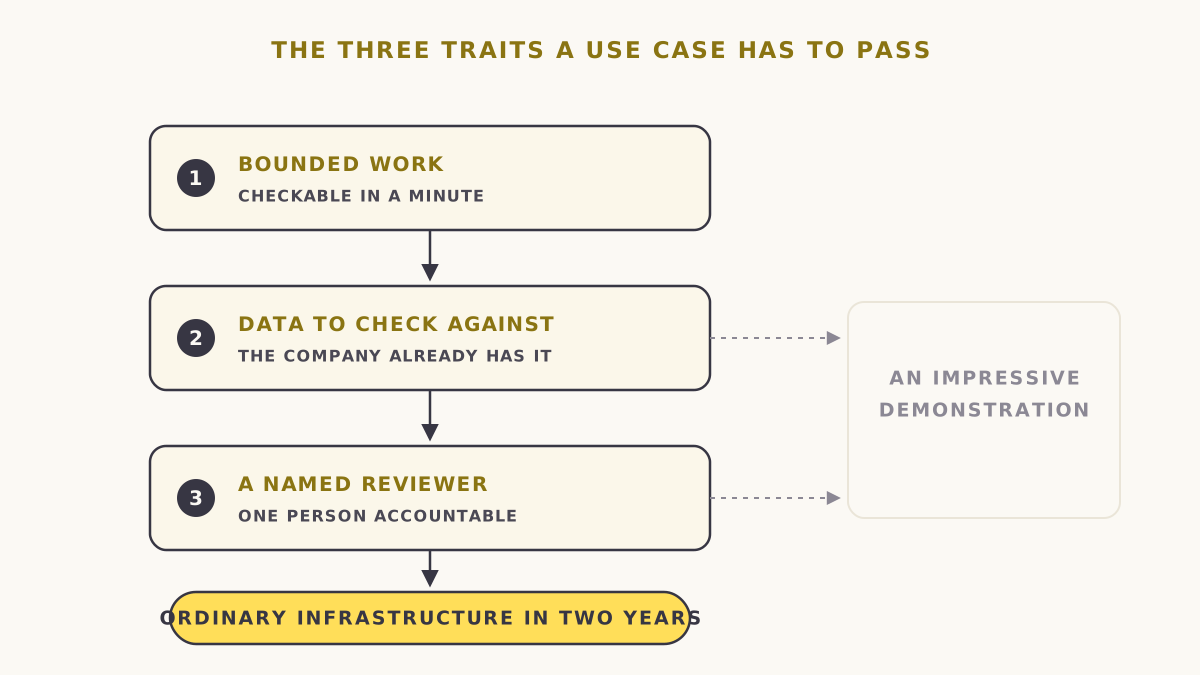
The use cases that delivered real value across every industry share three traits, and the industry itself turned out to matter far less than the traits. The work was bounded, with a definition of done somebody could check in under a minute. There was existing company data the output could be checked against. And one named person owned reviewing it. Anything with all three became ordinary infrastructure within two years. Anything missing the second or third trait produced impressive demonstrations and no durable value, in banking and in bakeries alike. If you are choosing where to start, choose by those three traits and ignore the industry list, including the one below.
Two years ago I published a list of generative AI use cases by industry. Manufacturing prototypes, retail personalization, medical documentation, fraud simulations, customer segmentation, code generation. It was an accurate list of what the technology could plausibly do.
Rereading it now, the useful thing is not what it got right. It is that the list turned out to be organized along the wrong axis.
Some of those use cases are so ordinary today that nobody calls them AI any more. Others produced a great demonstration, a pilot, a slide, and then quietly stopped. And the split between those two outcomes did not follow industry lines at all. The same use case succeeded in one company and evaporated in another down the street.
What actually decided it
Three traits. Every durable case I have seen since has all three, and I have not seen one succeed while missing the second or the third.
The work was bounded. One job, with a definition of done that the reviewing person could check in under a minute. Not "help with marketing". Draft this specific kind of message, from these inputs, in this format.
There was existing data to check the answer against. Something the company already held that made the output verifiable: a price list, an order history, a product catalogue, a written procedure. This is the trait that gets skipped, and skipping it is why a model produces something plausible instead of something true.
A named person owned the review. One human, by name, accountable for saying whether the output was good enough. No owner, no durable case. I have never once seen this filter fail to matter.
If those look familiar, it is because they are the same filters I use to pick the first process a business hands to an agent. That was not a coincidence I planned. It is the same underlying thing seen from two directions.
A case I can actually show you
I co-founded Sizebay in 2014, with Janderson and a third partner. It built virtual fitting room technology for fashion e-commerce and reached more than a thousand e-commerce clients in over fifty countries. It was acquired in 2024, and Janderson stayed through the earnout with a product focus until July 2026.
That last chapter is the part relevant here, and it is public rather than something you have to take my word for. At Fórum E-Commerce Brasil in 2025, the sector's main event in Brazil, the company presented Fashion Hub, which pairs generative AI with consumer behavior data for hyperpersonalization, with intelligent recommendations, image search and complete-look suggestions, alongside Size and Fit. The trade press covered it.
Look at that against the three traits. The work was bounded: recommend, search by image, suggest a complete look. The data existed and was substantial: years of real consumer behavior from a thousand retailers. And there were people whose job was to judge whether a recommendation was any good, because a bad one shows up immediately in a return.
That is why it is a product and not a demonstration. The generative part was the newest ingredient and the least decisive one.
The dog food
Holybiz runs on its own agents, and I mention it only because I would not tell you to do something we do not do.
Our own operation is small and deliberately so: we publish in three languages, we handle inbound, we run diagnoses, we keep our own board. Agents do a real share of that, and every one of them sits inside the same three traits. Bounded jobs. Our own written record to check against. One of us, by name, reviewing before anything reaches a person outside the company.
What I will not do is show you our internals, and I want to be straight about why. Partly because that is a rule we hold. Mostly because the architecture is not the transferable part. The transferable part is the discipline, and the discipline fits on an index card.
By industry, two years later
Since the slug of this article promises an industry list, here is the honest version. Read it as evidence about the three traits, not as a menu.
Retail and e-commerce. The clearest winner, and the least surprising. Recommendation, search, product copy at catalogue scale, sizing. All bounded, all sitting on top of behavioral data the retailer already had. What did not last: fully automated brand campaigns with nobody reviewing them.
Manufacturing. In 2024 I wrote about prototypes and simulation. What actually became ordinary was duller and closer to the office: procedures, documentation, quality reports, supplier correspondence. The plant floor moved slower than the paperwork around it, which is the opposite of what the 2024 list implied.
Professional and service businesses. The category the 2024 list did not have, and the one where I now do most of my work. Proposals, intake, scheduling, follow-up, the first reply. Small firms, high volume of repetitive written work, low cost of a correction. Structurally the best fit of any industry on this page.
Healthcare. Documentation and summarization stuck, hard, and largely because the review step was never optional. Diagnosis support remains a research and regulatory conversation, not a small-business one.
Financial services. Summarization, reconciliation drafting and document review lasted. Anything where a wrong number reaches a customer without a human in between did not, and should not.
Media and marketing. Production got cheap and quality got harder to see, which is the awkward outcome. The value moved to whoever still has judgment about what is worth producing. I wrote about the operational half of this in the piece about digital presence.
The pattern across all six: the winners were unglamorous, bounded, and sitting on data that already existed. Every single one of them.
If you are small, this is the part that matters
The 2024 version of this article ended with an implication I would now push back on: that a small business should look at what its industry is doing and copy it.
Do the opposite. Ignore the industry list. Take the four or five most repetitive pieces of written work in your week, and run the three traits against each one. The one that passes all three is where you start, and it will almost certainly be something boring that nobody would put in a case study.
Cloud AI did make this cheap, which was the true part of what I wrote in 2024. What I underestimated is that cheap access was never the constraint. The constraint is having something written down to check the answer against, and that has not gotten cheaper at all. It is still work, and it is still yours.
What this has to do with Holybiz
This is the whole shape of what we do with an owner: interview the operation, find out what the data already answers, and build only what is genuinely missing. Sometimes what is missing is an agent. Often what is missing is the written record that would let an agent be honest, and we say so.
We are a small firm and we work with small businesses, mostly service businesses in Brazil and the United States. I am not going to tell you we do pharmaceutical documentation or fraud simulation. The three traits travel across every industry on this page. Our engagements do not, and pretending otherwise would fail the first test I just gave you.
The industry was never the variable. Bounded work, existing data to check against, and one named reviewer were, and the last two are what companies skip.
Anything with all three traits became ordinary infrastructure in two years. Anything missing the second or third produced a demonstration and stopped.
Sizebay's AI chapter is a case you can check rather than take on trust: Fashion Hub and Size and Fit, presented at Fórum E-Commerce Brasil 2025 and covered by the trade press. The generative part was the newest ingredient and the least decisive.
Professional and service businesses were missing from my 2024 list and are structurally the best fit of any category, because the work is repetitive, written, and cheap to correct.
Ignore the industry list, including mine. Run the three traits against the repetitive written work in your own week.
Cheap access to models was never the constraint. Having something written down to check the answer against still is, and that is still your work.
Read next

Customers pay more to the company that looks like it knows what it is doing
A fast first reply, a visit with a checklist, a complete proposal, a short presentation and two follow-ups are not good manners. They are how a customer who cannot judge your work decides what it is worth, and the margin follows that judgment. The research on how people read price, design and trust, and what winning proposals actually contain.
Patricia de Castro Araujo·Oct 3, 2026
Your week has forty hours of work in it and sixty hours of business
Answering the phone, keeping the feed alive, finding a slot for an estimate, writing the quote, chasing the invoice. None of it is the job the customer pays for, and it is where most of a small-business owner's week goes. What the surveys actually measured, where the government data disagrees with the vendors, and which bucket to hand over first.
Patricia de Castro Araujo·Sep 26, 2026
The customer called while you were on the roof. Nobody answered.
Every service owner I interview tells me the same three stories: the reply that came too late, the quote that went out too late, the day lost confirming what was already agreed. Here is what the sources actually say those three hours cost, which famous numbers I refused to use, and why a company with seventy salespeople bleeds in exactly the same place.
Patricia de Castro Araujo·Sep 19, 2026